
Exterior-only washes run roughly $300 to $2,500 for single-engine and light aircraft, and $1,500 to $10,000 or more for jets, while a full interior-and-exterior detail on a large-cabin aircraft can reach $7,000 to $20,000. The biggest swing factor isn't size; it is condition, coatings, and how hard your aircraft is to reach on the ramp.
TL;DR:
- Heavy oxidation, exhaust staining, or deicing fluid deposits can significantly increase detailing costs, sometimes adding several thousand dollars for correction.
- Region, airport access, and logistics can cause quotes to vary widely, especially when additional services like coatings or paint correction are involved.
- Regular maintenance washes every three to six months prevent major oxidation and staining, reducing the likelihood of costly restoration work later.
- Reputable detailers require aircraft inspection or photos before quoting to ensure condition-based pricing and avoid surprise costs.
- Choosing providers with aviation-specific insurance, proven experience, and transparent estimates helps prevent damages and ensures quality service.
Table of Contents
- How Much Does Aircraft Detailing Cost by Aircraft Type?
- What Drives Aircraft Detailing Prices Up or Down?
- Core Aircraft Detailing Services and What They Cost You
- How Do You Get an Accurate Aircraft Detailing Quote?
- Does a Maintenance Plan Lower Your Total Aircraft Detailing Cost?
- How Do You Choose a Reliable Aircraft Detailer?
- Why Aircraft Detailing Is Asset Preservation, Not a Luxury Line Item
- Book Aircraft Detailing With Ssfdetail in Boca Raton
- Sources
- FAQ
How Much Does Aircraft Detailing Cost by Aircraft Type?
Aircraft detailing cost breaks down cleanly once you separate two variables: aircraft category and service level. A wash on a Cessna 172 costs a fraction of what a mid-size jet needs, and an exterior-only rinse costs a fraction of a full interior-and-exterior detail with brightwork restoration. Providers price this way because labor hours, not just square footage, drive the bill.
Below is a realistic reference range pulled from published pricing models across the industry. Treat it as a benchmark for evaluating quotes, not a fixed price list. Every provider inspects before quoting, and yours should too.
These bands echo what JetGlow Aviation publishes for exterior and full-detail work across categories, and they line up with the medium-jet figures SlashGear reports for interior-plus-exterior packages. Speedy K's pricing guide backs up the lower end for piston singles and light jets, especially where the aircraft is already in decent condition.
A few things push a quote toward the top of its range or past it entirely:
- Heavy oxidation or exhaust staining adds hours of compounding and polishing before any protective work can start.
- Deicing fluid residue on wings and control surfaces often needs a dedicated decontamination pass.
- Ceramic coating adds a significant premium. Onground Systems lists ceramic coating jobs at $3,500 to $12,000 depending on aircraft size and surface condition.
- Paint correction on aircraft with years of neglected oxidation can add several thousand dollars on its own, separate from the base detail.
- Region and airport access matter. A shop working out of a busy FBO in South Florida charges differently than one in a smaller regional market, partly because ramp fees, insurance requirements, and travel time vary by location.
Restoration work sits in an entirely different bracket. When an aircraft has gone years without proper care, corrective detailing on a large jet can climb toward $90,000 for a full paint and surface restoration. That number isn't a typical detailing bill. It's what deferred maintenance costs when oxidation has eaten into clear coat and brightwork has pitted past a simple polish.
Pro Tip: Ask any provider whether their quote assumes "average condition." If your aircraft hasn't been detailed in over a year, tell them upfront. A quote based on a photo you send today will always beat a surprise change order after the crew arrives on the ramp.
What Drives Aircraft Detailing Prices Up or Down?
Two aircraft of identical size can generate wildly different quotes. The gap almost always comes down to five factors, and understanding them lets you negotiate a quote instead of just accepting one.
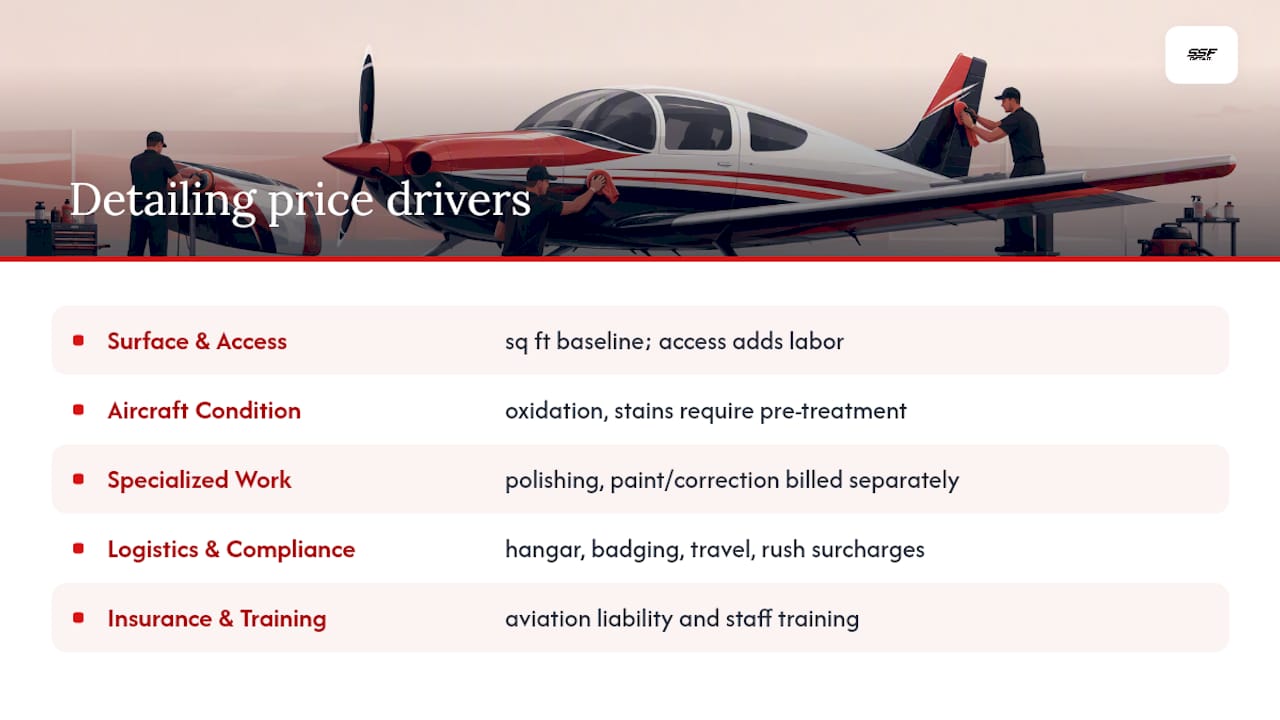
Surface area and access complexity. Square footage sets the baseline, but access is what actually eats labor hours. Wing tips, nacelles, tail cones, and belly panels take far longer to reach safely than flat fuselage skin, and every hour of extra scaffolding or lift work shows up on the invoice.
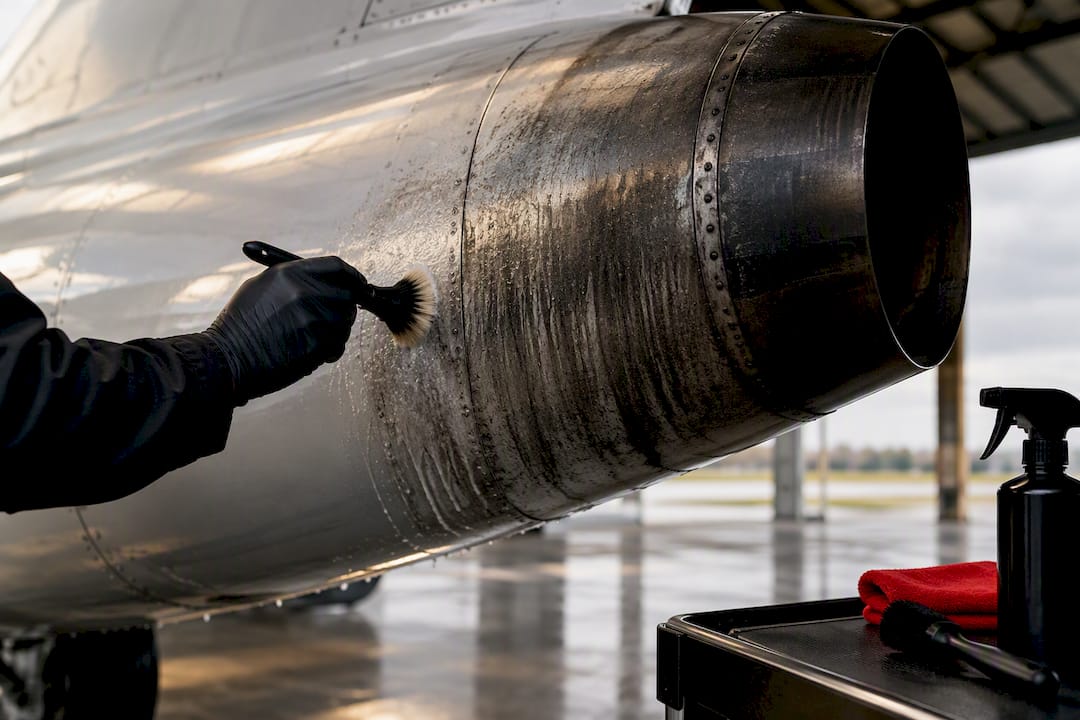
Condition walks the price up fast. Oxidation, exhaust streaking near the APU exhaust, deicing fluid staining, and insect residue from a summer on the ramp all require pre-treatment before a standard wash can even begin. A detailer quoting "flat rate, no inspection" is either guessing or planning to hit you with a change order later.
Specialized work gets priced separately. Brightwork polishing, paint correction, and coating application require different chemicals, tools, and skill levels than a standard wash. Providers rarely bundle these into a base price because the labor time is unpredictable until they see the metal up close.
Logistics and compliance add real cost. Hangar access versus open ramp work, airport security badging, and travel time to reach your location all factor into the quote. Rush jobs or after-hours requests carry steep surcharges, and Speedy K's notes that scheduling flexibility is one of the simplest ways owners reduce their total bill.
Insurance and training cost money, and that's a good thing. Reputable providers carry aviation-specific liability coverage and train staff on aircraft-safe chemicals that won't damage composite skins, seals, or avionics. That coverage and training show up in the price, and it's the reason a bargain quote often isn't a bargain at all.
Core Aircraft Detailing Services and What They Cost You
Every quote is really a bundle of separate line items, and knowing what each one includes helps you compare providers on equal footing instead of just comparing bottom-line numbers.
Exterior wash tiers range from a basic rinse and bug removal up to full decontamination with iron removal, oxidation treatment, and a finishing polish. The rinse tier handles routine grime; the full decontamination tier is what a neglected aircraft needs before it can even accept a coating.
Interior tiers run from a quick vacuum and wipe-down to a full cabin deep-clean covering leather conditioning, carpet extraction, galley sanitizing, and lavatory detail. Leather care alone can shift the interior price meaningfully if the seats haven't been conditioned in a year or more.
Brightwork and metal polishing covers exposed aluminum trim, exhaust stacks, and prop spinners. This is hand labor with specialized compounds, and it's priced separately because a single stubborn stain can turn a 30 minute job into a three hour one.
Add-ons worth budgeting for separately:
- Ceramic coatings add upfront cost but reduce wash frequency afterward, since dirt and staining bond less to a coated surface; learn more about preserving delicate finishes with matte paint protection.
- Paint protection film on leading edges protects against bug strikes and minor abrasion, extending paint life on high-cycle aircraft.
- Glass polishing removes fine scratching on windshields and side windows that a standard wash won't touch.
- Odor treatment addresses cabin smell from smoke, pets, or long-term storage.
- Rush or after-hours fees typically add a flat surcharge or percentage premium for same-day or off-schedule work.
How Do You Get an Accurate Aircraft Detailing Quote?
A comparable quote depends on giving every provider the same starting information. Skip a step here and you'll end up comparing apples to oranges when the bids come in.
- Send clear, well-lit photos of the whole aircraft, and call out trouble spots specifically: oxidation patches, exhaust staining, corrosion, or deep interior stains.
- Estimate your skin area or provide the aircraft's published dimensions, and flag any access constraints like low wing height or tight hangar clearance.
- Confirm your logistics upfront: hangar or ramp, availability of power and water on site, security badging requirements, and your preferred scheduling window.
- Request an itemized breakdown that separates exterior, interior, coatings, brightwork, and any rush fees, rather than accepting a single lump-sum number.
- Verify insurance and warranty terms in writing before booking, including liability limits and what happens if something gets damaged during the job.
Most reputable detailers won't finalize pricing without seeing the aircraft first, whether in photos or in person. That's not a stall tactic. It's standard practice, since a fair quote has to be condition-driven rather than guessed.
Pro Tip: Get quotes from at least two providers using the identical photo set and information sheet. If one quote comes back dramatically lower with no mention of inspection, that's a signal to ask harder questions, not a reason to celebrate.
Does a Maintenance Plan Lower Your Total Aircraft Detailing Cost?
Frequency changes the math more than most owners expect. Aircraft washed every 3 to 6 months rarely develop the heavy oxidation and staining that push a job into a higher price bracket, and industry practitioners consistently point to consistent scheduling as the single easiest way to keep detailing costs predictable rather than reactive.
A single-engine aircraft flown recreationally might only need detailing twice a year. A charter jet or fleet aircraft in constant rotation often benefits from monthly maintenance washes that keep grime from ever setting in.
- Regular washing prevents the oxidation buildup that turns a routine polish into a multi-hour paint correction job.
- Brightwork stays cleaner longer between visits, cutting down on the specialized metal-polishing time that costs extra.
- Ceramic coatings pay off fastest for high-cycle aircraft, since the coating reduces how often a full wash cycle is needed and cuts labor on every visit after prep.
- Bundling exterior and interior work into one visit usually costs less per service than scheduling them separately, since setup and travel time only happen once.
How Do You Choose a Reliable Aircraft Detailer?
The cheapest quote on the ramp is rarely the safest one. Aviation-grade detailing involves chemicals and access procedures that can damage composite skins, seals, and avionics bays if handled by someone without proper training, so vetting matters more here than it does with a standard car wash.
Look for these trust signals before you book:
- Documented experience on airframes similar to yours, ideally with before-and-after photos of comparable work.
- Current aviation liability insurance, not just general commercial coverage.
- An itemized quote that separates exterior, interior, and specialized work, rather than one flat number.
- Clear warranty language covering what happens if a coating fails prematurely or a surface gets damaged during service.
And watch for these warning signs:
- A flat-fee quote given without any inspection or photo review.
- No mention of aviation-specific insurance when you ask directly.
- No references and no visual proof of past work on similar aircraft.
- Vague answers about which chemicals or products they use on painted and composite surfaces.
Practitioners in the field routinely warn that the lowest bids often skip the insurance and training that protect your aircraft, and that shortcut tends to surface later as a much more expensive repair. Ask for a full scope of work and a product list before you sign anything, and confirm insurance limits in writing rather than taking a verbal assurance.
Why Aircraft Detailing Is Asset Preservation, Not a Luxury Line Item
Owners who treat detailing as optional cosmetic spending usually pay more over the life of the aircraft, not less. Oxidation and exhaust staining don't stay cosmetic. Left alone, they degrade paint and clear coat to the point where a routine polish turns into a restoration job costing tens of thousands more than consistent maintenance ever would.
At Ssfdetail, every vehicle we service, from luxury cars to boats to aircraft, gets the same standard: personal inspection, honest scoping, and a plan built around actual condition rather than a guess. That's the mindset owners should apply when reviewing quotes. Prioritize the provider who inspects before pricing, asks about your coating history, and can speak plainly about their insurance coverage. The cheapest number on paper rarely stays the cheapest number in practice.
— Martin
Book Aircraft Detailing With Ssfdetail in Boca Raton
Ssfdetail is the alternative to guessing your way through ramp-side quotes. Every job, whether it's a car, a boat, or an aircraft, gets personally inspected and approved by owner Steven Shames before a single panel gets touched, so you get a scope built around your aircraft's actual condition instead of a flat-rate guess that ignores oxidation or staining until it's too late.
We bring mobile detailing capability and attention to detail to aircraft owners in Boca Raton and the surrounding area, covering exterior decontamination, interior deep-cleaning, brightwork restoration, and coating prep and application. If you're weighing a ceramic coating for your aircraft's exterior or wondering how a recurring maintenance plan could lower your per-visit cost, that's exactly the kind of question we sort out during inspection, not after.
To get a real number instead of a rough guess, send us clear photos of your aircraft along with your hangar or ramp access details, and request a quote through our aircraft and private jet detailing page. We'll scope the job, confirm logistics, and give you an itemized quote before any work starts.
Sources
- How Much Does It Cost to Detail a Private Jet?
- Aircraft detailing prices: how much does it cost to detail an aircraft
- How much does it cost to detail a private jet? (SlashGear)
- How much does airplane detailing cost? - Speedy K's
- Private Jet Detailing in Northern Virginia | Pro Detailing | Aircraft Detailing
FAQ
Do Aircraft Detailers Make a Lot of Money?
Earnings vary widely based on scale, aircraft mix, and whether the business serves individual owners or fleet and charter operators. High-end providers working on large-cabin jets with coating and restoration services generally earn more per job than those focused on light single-engine aircraft, since full detail packages on large jets run $7,000 to $20,000 or more.
Do You Need a License to Detail Planes?
There's no dedicated federal license required just to wash and detail an aircraft exterior or interior. What matters more in practice is training on aviation-safe chemicals and proper handling around sensitive components like antennas, static wicks, and control surfaces, since the wrong product can cause real damage.
What Are the FAA Requirements for Aircraft Detailing?
The FAA doesn't license detailing itself, but any work that touches flight-critical surfaces, fasteners, or structural components can cross into maintenance territory governed by FAA rules. Reputable detailers stay within cosmetic and cleaning boundaries and defer any structural or corrosion repair to a certified airframe shop.
How Much Does It Cost to Wash a Cessna 172?
A basic exterior wash on a Cessna 172 typically falls in the $300 to $1,000 range, depending on condition and region, based on industry pricing data for single-engine piston aircraft. A full interior-and-exterior detail runs higher, generally $500 to $1,500, once interior cleaning and any oxidation treatment are added.
How Much Does Aircraft Detailing Cost With Ssfdetail?
Ssfdetail prices aircraft detailing based on a personal inspection of your specific plane, since condition and access vary too much for a flat rate. Current pricing details are available by requesting a quote through the aircraft and private jet detailing page.