
Expect to pay $7 to $10 per foot for a maintenance wash, $10 to $40 per foot for a full detail, and $35 to $125 or more per foot for heavy correction or restoration work. Ceramic coating prices vary depending on boat size, and certified installs are generally charged per foot. The single biggest swing factor is gelcoat oxidation. A shop cannot hand you a firm number until someone walks the boat and looks at the hull.
TL;DR:
- Heavy correction work for severely oxidized gelcoat can cost between $35 and $125 per foot, with restoration of a 25-foot boat potentially exceeding $5,000.
- A full detail generally ranges from $10 to $25 per foot, but extensive correction or restoration can significantly increase the total price.
- The condition of the hull and oxidation stage are the most influential factors, with light oxidation requiring only polish and severe cases needing sanding and multiple passes.
- Additional surfaces like teak, canvas, or engine compartments add to the price, especially if they require separate cleaning techniques and products.
- For accurate quotes, owners should provide detailed photos and ask shops whether correction costs are included or separate, avoiding vague flat-rate estimates.
Table of Contents
- How Much Is Boat Detailing? Price Bands By Service Tier
- What Does Boat Detailing Cost For an 18', 22', 25', or 30' Boat?
- What Drives the Price of Boat Detailing Up or Down
- How to Get an Accurate Boat Detailing Quote
- DIY Boat Detailing vs Hiring a Professional
- What SSF Detail Does Differently on Marine Work
- Prioritize Prevention Over Restoration
- Request a Marine Detailing Estimate
- Sources
- FAQ
How Much Is Boat Detailing? Price Bands By Service Tier
Every quote you get back is going to fall into one of four buckets. Knowing the boundaries of each one before you call around saves you from comparing apples to oranges, which is the single most common mistake we see boat owners make when shopping detailing services.
Maintenance wash is the entry-level service tier, and it's priced accordingly at $7 to $10 per foot. This covers a soap wash, glass cleaning, a vinyl wipe down, and a protectant spray. It is not a correction service. Think of it as the boat equivalent of a car wash: it keeps grime from building up, but it does nothing for oxidation that has already set into the gelcoat.
A standard full detail is where most owners land, and pricing runs $10 to $25 per foot on the conservative end, stretching up to $40 per foot depending on region and boat complexity. This tier typically includes exterior decontamination (removing salt film, waterline scum, and light rust staining), vinyl and metal cleaning, interior vacuuming and spot cleaning, and a light polish pass. It's the boat detailing equivalent of a full-service auto detail: thorough, but not a paint correction job.
Multi-stage correction and restoration is where the real cost jumps happen. Heavier correction work, involving compounding, wet sanding of severely oxidized gelcoat, and multiple polish stages, can run $35 to $125+ per foot depending on how far gone the surface is. A 25-foot boat with severe oxidation can run from around $875 for a basic detail-and-protect package up to $5,000 or more for a full restoration, according to industry pricing data from ShopBoatJuice.
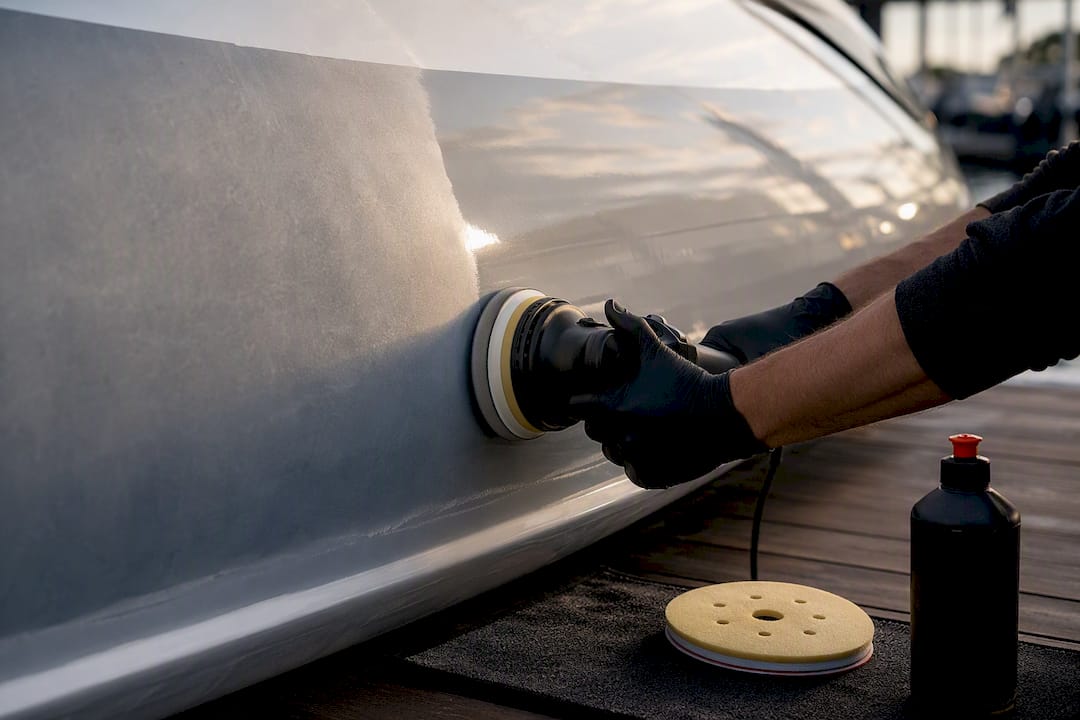
Ceramic coating and long-term protectants sit at the top of the pricing ladder. Quoted totals commonly range from $600 to $3,000 depending on boat size and how much correction prep the surface needs before coating goes on. Certified installs are typically priced at $60 to $125 per foot, and the process usually takes 3 to 5 days once the boat is in the shop. That timeline includes decontamination, correction, and cure time, not just spray-and-go application.
Here's the tier breakdown in one place:
- Maintenance wash: $7 to $10/ft, wash + glass + vinyl wipe + protectant
- Standard full detail: $10 to $25/ft (up to $40/ft in some markets), decontamination + vinyl/metal + interior + light polish
- Multi-stage correction/restoration: $35 to $125+/ft, compounding + sanding + multi-stage polish
- Ceramic coating: $600 to $3,000+ total, or $60 to $125/ft for certified installs, 3 to 5 day timeline
If you want to explore where certified coatings fit into a broader vehicle protection plan, our guide to ceramic coating costs breaks down the economics in more depth.
What Does Boat Detailing Cost For an 18', 22', 25', or 30' Boat?
Per-foot math only becomes useful once you attach it to a real hull length. Here's how the bands translate into dollar figures for four common boat sizes, based on a mid-range full detail estimate and the oxidation-driven correction tier.
For an 18-foot boat, a maintenance wash lands around $126 to $180. A standard full detail runs roughly $180 to $450, and if the gelcoat needs real correction work, expect $630 to $2,250 or more. This size covers a lot of center consoles, small bowriders, and jet ski trailers.
A 22-foot boat, a common pontoon or bowrider length, runs $154 to $220 for a maintenance wash and $220 to $550 for a standard detail. One detailer's published baseline puts a 22-foot pontoon at roughly $374 for a standard job using a $17 per foot working rate, with heavy oxidation adding another $200 to $600 on top of that number depending on hull condition.
A 25-foot boat is the size most cost guides use as their reference point, and for good reason: it's the crossover point where restoration pricing gets serious. A detail-and-protect package on a 25-footer can run around $875, while severe restoration can climb past $5,000 once you factor in heavy sanding and multi-stage compounding.
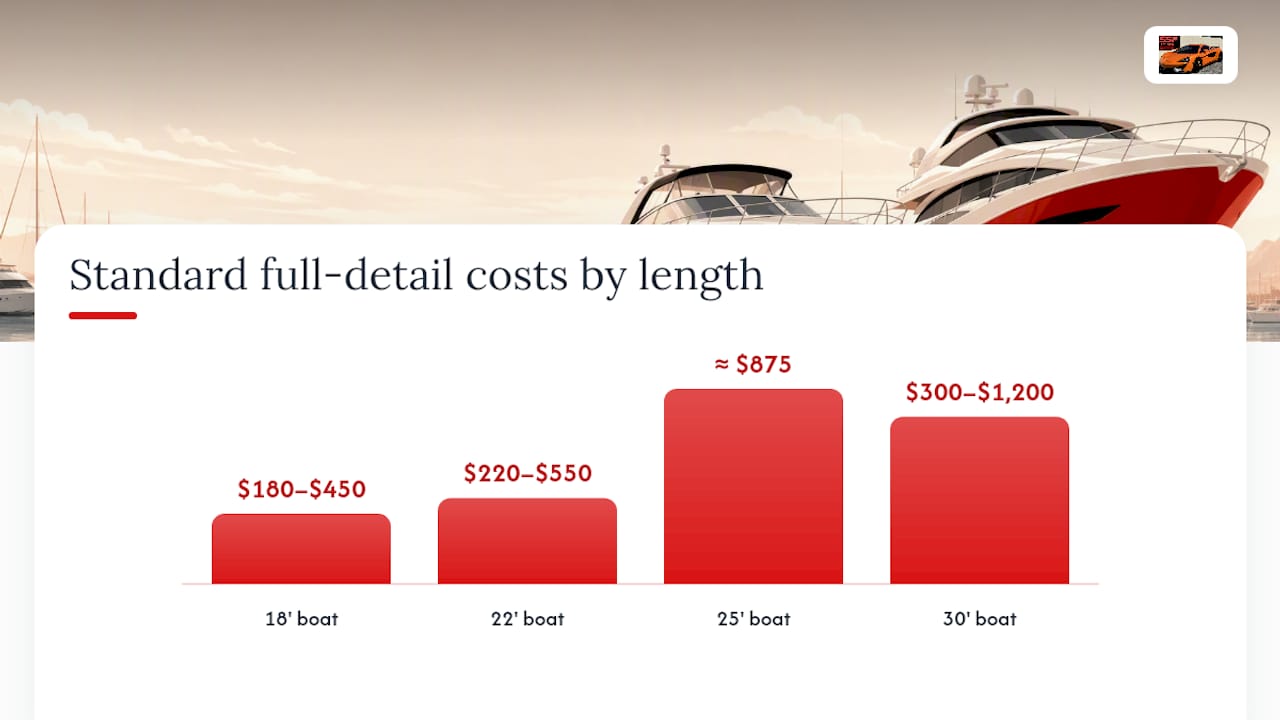
A 30-foot boat pushes maintenance washes to $210 to $300 and full details to $300 to $1,200, with correction-tier work easily crossing $1,050 to $3,750 or more.
A few craft-specific notes worth knowing before you call for a quote:
- Pontoons add hours for rail and fence cleaning, even though the flat deck itself is quick to wash.
- Boats with towers, hardtops, or radar arches add real labor time for reaching and detailing elevated surfaces.
- Cabin boats need interior detailing on top of the exterior work, which stacks additional hours onto any tier.
- Trailer detailing is usually a separate line item, not folded into the per-foot hull rate.
- Jet skis and small tenders are typically priced as flat fees ($75 to $200) rather than per-foot, since their surface area doesn't scale the same way.
What Drives the Price of Boat Detailing Up or Down
Two boats of identical length can generate wildly different quotes, and the reason almost always traces back to one of five variables.
- Surface condition and oxidation stage. A boat with light, recent oxidation might need a single-stage polish. A boat that's sat outside for three summers with chalky, faded gelcoat needs wet sanding and multiple compounding passes before polish even enters the conversation. This single variable is why the correction tier spans such a wide range, $35 to $125+ per foot, compared to the tighter maintenance and full-detail bands.
- Scope beyond the hull. Teak decking, canvas biminis, vinyl seating, engine compartments, and brightwork (chrome and stainless trim) each require separate techniques and products. A quote that only covers hull and glass will look cheaper than one that includes teak conditioning and canvas treatment, but you're not comparing the same job.
- Access and logistics. Dockside detailing is more convenient for the owner but can limit water access and add setup time for the detailer. Haul-out and in-shop work often allows faster, more controlled correction, but you may pay a haul-out or transport fee on top of the detailing bill.
- Materials and product tier. A basic wax job might use consumer-grade product and last a few months. A certified ceramic coating uses industrial-grade coating chemistry applied under controlled conditions, and that premium shows up in both the per-foot rate and the warranty backing it.
- Turnaround time. Rush jobs squeezed into a tight weekend window before a trip often carry a scheduling premium, especially for coating work that needs 3 to 5 uninterrupted days to cure properly.
Pro Tip: Ask every detailer the same direct question: "Does your quote assume light oxidation, or has someone actually looked at my hull?" A number given over the phone without a visual inspection is a starting estimate, not a real quote.
How to Get an Accurate Boat Detailing Quote
Getting comparable quotes from two or three shops requires giving them comparable information. Most pricing disputes happen because one detailer assumed light oxidation and another assumed heavy correction, based on nothing more than a text message description.
Before you call anyone, take these photos and short videos: a full side shot of the hull in daylight, close-ups of any chalky or discolored oxidation spots, a shot of the waterline, interior seating and flooring, canvas and teak if you have them, and the engine compartment. Send all of it along with your boat's exact length and hull material.
When you talk to a detailer, ask these questions directly:
- Is your pricing per-foot or a flat rate for my boat's size and condition?
- What condition are you assuming based on the photos I sent?
- Is oxidation correction included in that number, or is it a separate line item?
- What warranty comes with the work, especially for wax or ceramic coating?
- Are materials and products included in the quoted price?
- If I'm getting a ceramic coating, what's the cure time before the boat can go back in the water?
- Are there haul-out or dockside access fees on top of the detailing charge?
Request a written, itemized estimate rather than a verbal ballpark. A quote that just says "full detail: $500" without breaking out what's included is a red flag worth pushing back on, since "detail" means different things to different shops. Be especially wary of any number that seems too low given visible oxidation in your own photos. That gap usually gets made up later as an "unexpected" add-on once the work has already started.
DIY Boat Detailing vs Hiring a Professional
Doing it yourself isn't free, and it isn't fast; investing in marine-grade cleaners and protectants from the Diamondbrite Online Shop can improve your DIY results but adds to upfront costs. A basic DIY setup, dual-action polisher, compounding and polishing pads, marine-specific cleaners, and wax or sealant, typically costs $320 to $740 upfront in equipment and product. Labor time runs 8 to 20 hours depending on boat size and how much correction the gelcoat needs.
Run the math on a 25-foot boat: DIY equipment costs $500 (average), plus a full weekend of your own labor, versus a professional full detail at $250 to $625 (at $10 to $25 per foot). Once you factor in your own time at any reasonable hourly value, professional detailing frequently comes out ahead, especially for boats that need actual correction rather than a simple wash.
Compounding and wet sanding are not beginner-friendly tasks. Applying too much pressure or the wrong pad speed can burn through thin gelcoat, turning a $500 detailing job into a $2,000+ gelcoat repair. This is the main reason restoration-level work is usually best left to a pro: the skill floor is higher than most owners expect, and mistakes are expensive to fix.
The long-term economics favor prevention. Maintenance cleaning starts low and stays predictable. Heavy oxidation and restoration are where costs escalate unpredictably, which is exactly why a scheduled maintenance plan or a certified ceramic coating pays for itself over several seasons rather than costing you a restoration bill down the road.
- DIY equipment: $320 to $740 upfront, plus 8 to 20 hours of labor
- Professional full detail: $250 to $1,200 depending on size, no equipment investment
- Restoration mistakes from DIY compounding can cost more to repair than the original detail would have cost
What SSF Detail Does Differently on Marine Work
A premium marine detailing shop earns its higher price point by treating every stage as its own line item rather than bundling everything into one vague number. The shop has serviced many vehicles across cars, boats, and private aircraft, with owner personal review of each job before completion.
That approach carries over directly to marine detailing. Prep work, gelcoat conditioning, and coating installation are scoped and priced separately, so you know exactly what you're paying for at each stage rather than guessing what's baked into a flat number. Ceramic coating installs happen in a controlled setting rather than dockside, which matters for cure quality and longevity, and ongoing maintenance plans are built specifically to protect that investment season after season.
When you request a quote from a shop operating at this level, expect an actual walk-around inspection, a written itemized estimate broken out by stage, and a realistic timeline instead of a same-day promise that skips the prep work entirely.
Prioritize Prevention Over Restoration
Boat owners consistently underspend on prevention and overspend on emergency correction. The math is simple: a maintenance wash two or three times a season costs a few hundred dollars total. Waiting three years and then paying for full oxidation correction can cost more than a decade of maintenance would have.
Budget for detailing the same way you budget for oil changes, annually, not as an emergency line item after the gelcoat has already gone chalky. When you get quotes, favor shops that walk you through correction stages rather than handing you a single flat number with no explanation of what's included.
If your hull needs heavy compounding or sanding, hire a professional. The margin for error on that kind of work is thin, and a botched DIY attempt on damaged gelcoat almost always costs more to fix than the original job would have cost.
— Martin
Request a Marine Detailing Estimate
If you'd rather skip the guesswork of comparing per-foot rates across three different shops, Marine detailing services typically provide an itemized quote built around your boat's actual condition rather than a phone-call estimate. The team handles everything from routine maintenance washes to full ceramic coating installs, with personal inspection standards applied to each vehicle serviced.

Booking starts with an on-site or photo-based inspection, followed by a written estimate that breaks out prep, correction stage, and any coating work as separate line items, so you know exactly what's driving your total before work begins. Expected timelines are set upfront, whether that's a same-day maintenance wash or a multi-day ceramic coating cure. For boats that need ongoing protection between visits, ask about maintenance plan options during your consultation.
Ready to see what your boat actually needs? Request a marine detailing estimate and get a real, itemized number instead of a rough per-foot guess.
Sources
The price bands in this guide draw from published marine detailing cost data, including per-foot pricing breakdowns from ShopBoatJuice and Lionheart Detailing, a real-world per-foot baseline example from Mobile Detailing Services, ceramic coating economics from Custom Marine Finishes, and coating timeline data from CGAA. Each source was chosen for a specific piece of the puzzle: per-foot pricing, oxidation surcharge data, or coating cost-over-time analysis, so the ranges in this guide reflect actual market pricing rather than a single shop's estimate.
- Cost to Detail a Boat: 2026 Guide to Pro vs. DIY Prices
- How Much Does Boat Detailing Cost? (2026 Guide)
- Ceramic Coatings vs Wax: True Cost Over 5 Years | Custom Marine Finishes
- How Much Does It Cost to Ceramic Coat a Boat? Comprehensive Answer
- Boat Detailing Cost: 2026 Guide for Columbus
FAQ
How much does it cost to get a boat detailed?
A standard full detail typically runs $10 to $25 per foot, meaning a 25-foot boat lands around $250 to $625 for a basic detail-and-protect job. Heavy oxidation correction or restoration can push costs to $35 to $125+ per foot.
How much to charge for a full detail on an 18-foot boat?
At the standard full-detail rate of $10 to $25 per foot, an 18-foot boat runs roughly $180 to $450. If the gelcoat needs correction work, that number can climb toward $630 to $2,250 depending on oxidation severity.
What does a full boat detail include?
A standard full detail covers exterior decontamination, vinyl and metal cleaning, interior vacuuming and spot cleaning, glass cleaning, and a light polish pass. It does not typically include multi-stage compounding or ceramic coating, those are separate, higher-priced tiers.
How much is it to buff and polish a boat?
Buffing and polishing falls into the multi-stage correction tier, which runs $35 to $125+ per foot depending on how oxidized the gelcoat is. Light polish work included in a standard full detail costs less; heavy compounding for severe oxidation costs significantly more.