
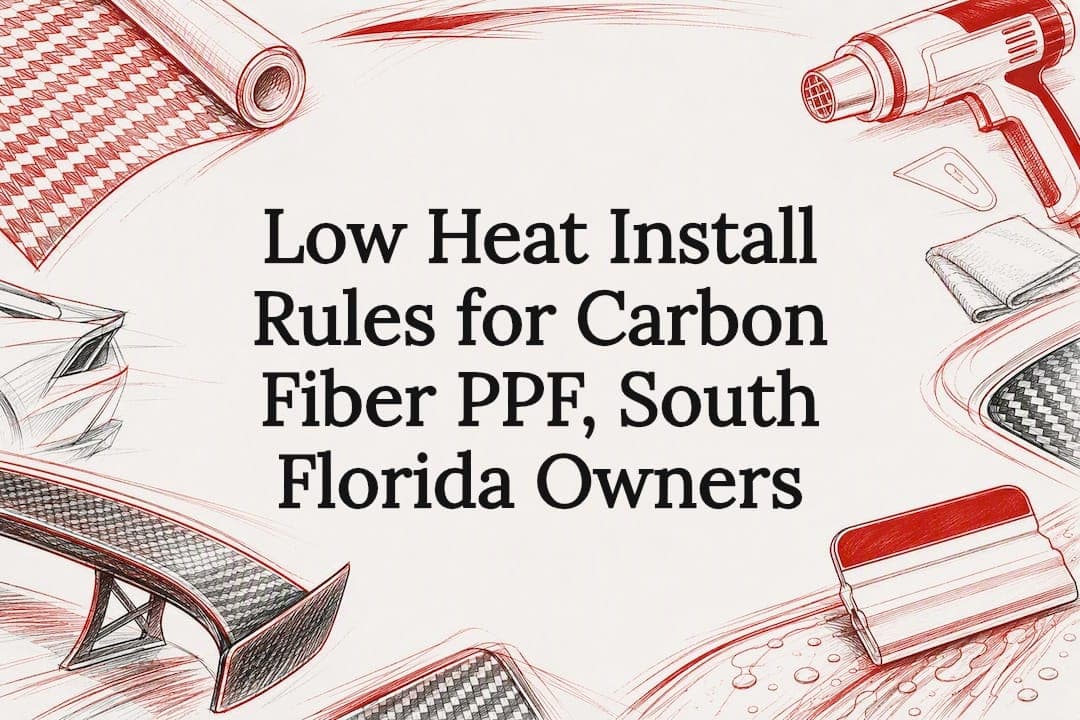
Carbon-pattern PPF is a textured TPU film that mimics forged or woven carbon fiber while adding real protective properties: hydrophobic topcoats, self-healing resins, and impact resistance. You can use it on genuine carbon fiber parts, and we recommend it for owners who want both the look and the protection, but the job depends entirely on the shop's experience with cure windows, surface prep, and edge strategy.
TL;DR:
- Carbon-pattern PPF offers impact resistance, self-healing, and hydrophobic protection while replicating the look of forged or woven carbon fiber, making it suitable for high-contact panels.
- Applying PPF on carbon fiber parts requires careful surface prep and fully cured clear coats to prevent edge lift, bubbling, or solvent pop, with proper sequencing critical for success.
- Gloss finishes deliver the deepest contrast and easiest maintenance, while matte options provide a subtle look but are more prone to showing fingerprints and swirl marks.
- Pricing varies based on panel size, film thickness, and complexity, with full vehicle wraps and carbon-specific panels costing significantly more due to detailed templating and handling.
- Installation quality depends more on experience with carbon parts and correct process adherence than on the brand of film used.
Table of Contents
- What Is Carbon Fiber PPF and How Does It Differ From Clear Film?
- Can You Put PPF on Carbon Fiber Parts?
- Gloss, Matte, Forged, and Woven: Choosing a Finish
- How Installers Handle Heat, Stretch, and Edges
- What Does Carbon Fiber PPF Cost?
- How to Choose an Installer for Carbon Fiber PPF
- SSF Detail's Approach to Carbon Fiber PPF Installs
- When Carbon-Pattern PPF Makes the Most Sense
- Get a Quote for Carbon Fiber PPF at SSF Detail
- Sources
- FAQ
What Is Carbon Fiber PPF and How Does It Differ From Clear Film?
Carbon fiber PPF starts as the same thermoplastic urethane (TPU) base used in clear paint protection film, but it's manufactured with a textured, patterned layer that replicates the woven or forged look of real carbon. Most versions carry the same functional topcoats you'd expect on a quality clear film: hydrophobic surfaces that shed water and grime, and self-healing resins that use heat, usually from the sun or warm water, to smooth out light swirls and scratches.
Where it splits from other protective and cosmetic products comes down to construction and purpose.
- TPU PPF (clear or carbon-pattern): A urethane film built for impact resistance, designed to absorb rock chips and resist abrasion while self-healing minor marring.
- Vinyl wraps: Thinner, less impact-resistant, and generally chosen for color change or graphics rather than rock-chip protection. Vinyl doesn't self-heal and tends to show wear faster in high-contact zones like door edges and rocker panels.
- Real carbon fiber components: A structural composite, not a film. Real carbon parts add stiffness and weight savings; the pattern is a byproduct of the weave, not an applied finish.
Some carbon-pattern films use a dual-layer build, where a printed or textured layer sits under a clear urethane cap. According to TeckWrap's carbon fiber PPF line, this construction lets manufacturers combine the protective topcoat with a convincing forged or woven visual, without needing an actual carbon layup underneath. That's the appeal for a lot of owners: you get the visual upgrade on a hood, mirror cap, or splitter without paying for (or waiting on) a custom carbon part, and you keep the protective benefits TeckWrap highlights as core to the product.
The functional gap between carbon-pattern PPF and vinyl matters most in the areas that take abuse. A vinyl-wrapped mirror cap will scuff and peel at the leading edge within a season or two of highway driving. A quality TPU carbon film in the same location shrugs off the same debris and heals its own light scratches. That difference alone explains why most performance shops steer style-focused clients toward film rather than wrap when the goal is a carbon look that survives real-world driving.
Can You Put PPF on Carbon Fiber Parts?
Yes, and it's one of the more common requests we get for splitters, mirror caps, spoilers, and hoods. The compatibility question isn't really about whether PPF sticks to carbon fiber. It's about what surface the PPF is bonding to, and that surface varies more than most owners expect.
Bare carbon fiber, before any clear coat is applied, has a different surface energy than a fully cured painted panel. Lower surface energy makes it harder for adhesives to form a lasting bond, which is why CyPaint's application guide recommends careful surface prep and, in many cases, a thinner and more pliable film that can conform to the exposed weave pattern without distorting it. Textured carbon surfaces amplify small prep mistakes. Wax residue, mold release agents, or an uneven clear coat all show up more visibly on a woven pattern than they would on flat painted steel.
The failure modes installers watch for on carbon parts include:
- Edge lift — the film's edge peels back over weeks or months, usually from insufficient adhesive activation or applying PPF before the clear coat has fully cured.
- Bubbling — trapped air or solvent that never fully released during install, often worse on textured surfaces where the weave creates uneven contact points.
- Solvent pop — small craters or pinholes that form when solvents in a fresh clear coat outgas through the film during cure, a risk that rises sharply when PPF goes on too soon after a paint job.
The sequence installers use to minimize all three: let the carbon part's factory or refinished clear coat cure fully first, verify that cure, then install the PPF. Carbonss Tuning's installation sequence guide frames this as the standard approach among experienced shops, since a fully cured clear coat gives the film adhesive a stable, predictable surface to bond to. Rushing that cure window is one of the most common reasons carbon-part PPF jobs fail warranty inspection.
There are situations where a PPF-first approach makes sense, usually when a part ships pre-coated from the factory with a verified cure date, or when the shop is applying film to a raw carbon part that will never see additional clear coat. Those cases require more conservative handling and, often, a thinner film spec to avoid telegraphing every fiber of the weave through the surface.
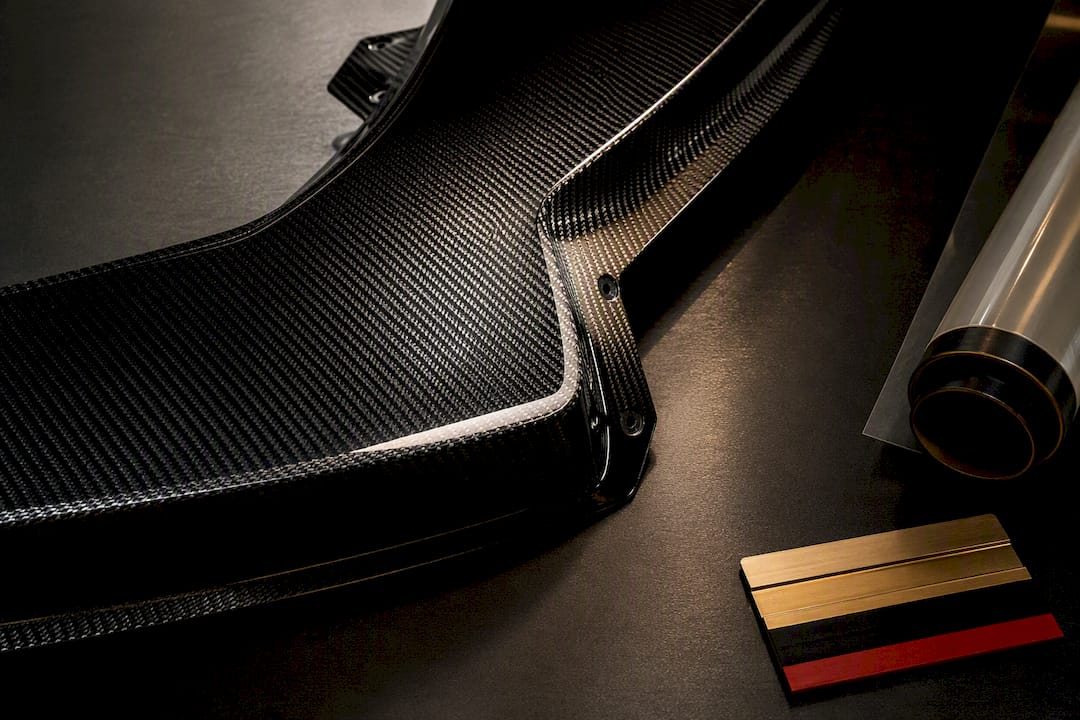
Pro Tip: Ask your installer how long they let a refinished carbon part cure before wrapping it in film. If the answer is "same day" or they seem unsure, that's worth a second opinion before you book.
Gloss, Matte, Forged, and Woven: Choosing a Finish
The finish you pick affects more than looks. It changes how the panel ages, how it photographs, and how much maintenance it demands.
Gloss carbon-pattern film delivers the deepest contrast and the most "wet look" shine, which is why it dominates on hoods, splitters, and mirror caps where owners want the pattern to pop. Matte versions trade that shine for a more understated, motorsport-inspired look, but matte finishes generally show fingerprints, water spots, and swirl marks more readily since there's no gloss to mask minor surface imperfections.
- Gloss forged or woven carbon: Highest visual impact, easiest to maintain with standard wash routines, most forgiving of light swirling.
- Matte carbon patterns: Sleeker, lower-key appearance, but requires pH-neutral soaps and softer wash media to avoid burnishing the texture over time.
- Forged patterns: Mimic the random, marbled look of forged carbon composite parts; realistic at a glance but can show slight print lines at extreme close range on some films.
- Woven patterns: Replicate the traditional 2x2 or plain weave; more precise repeating geometry, which can occasionally look "too perfect" compared to a real weave under certain lighting.
Thicker, forged-style fashion films, like the roughly 10-mil construction STEK USA specifies for its DYNOforged line, lean toward better edge durability and impact resistance, which matters most on front-facing panels like splitters and rocker extensions.
One quirk worth knowing before you commit to a dual-layer film: STEK USA notes that water can temporarily intrude between the layers during washing or heavy rain. It usually evaporates without lasting damage, but it can cause short-term edge discoloration that alarms owners who aren't expecting it. A proper edge seal at install time reduces how often this happens.
Adding a ceramic coating over carbon-pattern PPF is common practice and generally compatible when the film is installed correctly. Peak PPF's product documentation confirms fashion films are designed to work with ceramic coatings, polishes, and quick detailers, which is why a lot of our clients pair the two for extra gloss depth and easier maintenance. If you're weighing whether a coating adds enough value to justify the extra cost, our breakdown of PPF versus ceramic coating walks through where each one earns its place.
How Installers Handle Heat, Stretch, and Edges
Carbon fiber's resin matrix doesn't tolerate the same heat load that steel or aluminum panels shrug off without issue. Professional installers avoid high-temperature heat guns on carbon parts, relying instead on low, controlled heat paired with careful hand tension to mold film around contours without stressing the resin underneath.
Here's the process a competent shop follows on a complex carbon panel:
- Test the surface first. A dyne test (or a simple water-break test) confirms whether the panel's surface energy is high enough for reliable adhesion before any film goes near it.
- Set conservative heat limits. Techs work at lower gun temperatures than they'd use on painted metal, checking the panel's surface temperature rather than guessing by feel.
- Respect the bend radius. Every film has a practical minimum wrap radius; sharp aero edges, like a splitter lip or a vented hood edge, often need a different film weight or a modified wrap approach rather than forcing a film past its limit.
- Choose the right edge strategy. A partial wrap that stops just short of a sharp edge, sealed with a thin ceramic top layer, often outperforms a full wrap-around on extremely tight edges where the film would otherwise stretch too thin and reveal the substrate color underneath.
- Document the cure window. A shop that tracks how long a part cured before install, and how long you should wait before washing it, is showing you they treat sequence as a variable to manage, not an afterthought.
Pro Tip: Walk the prep area before you book. A clean, dust-controlled space and a tech willing to explain their edge strategy on your specific panel tells you more about install quality than any brochure.
Full edge wraps aren't always the wrong call. On broader, more forgiving curves, like a hood's leading edge or a mirror cap's outer shell, a full wrap gives cleaner protection with no exposed film edge to catch on a wash mitt. The decision comes down to the specific panel's geometry, and a shop with real carbon-part experience will tell you which edges deserve which treatment instead of applying one method to every panel by default.
What Does Carbon Fiber PPF Cost?
Pricing for carbon-pattern PPF tracks the same general shape as clear PPF pricing, but complexity on carbon parts usually pushes the number higher than an equivalent painted panel.
- Single-panel installs (a mirror cap, a splitter lip, a spoiler) sit at the lower end of the range, since labor time and material use are limited.
- Partial front-end packages (hood, fenders, bumper) cost more due to compound curves that demand more film, more heat-forming time, and often custom-cut templates rather than pre-cut kits.
- Full-vehicle wraps represent the top of the range, since every panel needs individual templating, and carbon-specific panels within that scope add extra labor for the low-heat, careful-tension approach we described above.
A few factors move the number inside those bands more than anything else:
- Film thickness and brand specs. Thicker, forged-style constructions like Peak PPF's roughly 7.5-mil-plus fashion films or STEK's heavier DYNOforged line cost more than a thinner standard clear film.
- Self-healing topcoat quality. Films with proven, warrantied self-healing resin generally command a premium over generic patterned vinyl marketed as "carbon film."
- Combined services. Bundling PPF with ceramic coating on the same visit often runs less than booking each service separately, and it protects your warranty registration since both services get documented on the same install date.
- Warranty terms. Some manufacturers back their fashion films with extended coverage. Peak PPF lists a 10-year limited warranty on some of its products, which affects the quoted price versus an unwarranted or shorter-term film.
Treat a vague, one-line quote as a warning sign rather than a bargain. If a shop can't break down film brand, thickness, and expected labor hours for your specific panels, you likely won't get the tailored heat and edge handling carbon parts actually need.
How to Choose an Installer for Carbon Fiber PPF
The install matters more than the film brand on carbon parts, because even a premium film fails if the surface prep or heat handling is wrong.
- Ask for the exact film SKU, not just a brand name. "Forged carbon film" isn't a spec; a specific product line tells you the thickness, warranty, and construction you're actually paying for.
- Ask how they handle carbon parts specifically, including cure windows before install and the low-heat approach they use for tight contours. A shop with real experience will have a clear, specific answer, not a general one about "PPF installs."
- Ask about edge strategy for your particular panels: full wrap, partial wrap with ceramic seal, or a hybrid approach depending on the edge's sharpness.
- Request proof: install photos of prior carbon-part work, a written scope of what's included, and documentation of how they register your warranty.
- Watch for red flags: refusal to explain their sequence, no mention of cure timing, ambiguous or missing warranty terms, or a quote that reads like a single flat number with no breakdown.
A shop confident in its process will walk you through all of this without hesitation. One that dodges specifics is telling you something too.
SSF Detail's Approach to Carbon Fiber PPF Installs
Carbon-pattern PPF requests have become one of the more frequent specialty jobs on some vehicle detailing schedules, particularly on splitters, mirror caps, hoods, and spoilers for performance-oriented owners in the Boca Raton and South Florida area. Every install is carefully approved before a vehicle leaves, which matters most on jobs like these where edge strategy and cure timing decide whether the install still looks right a year later.
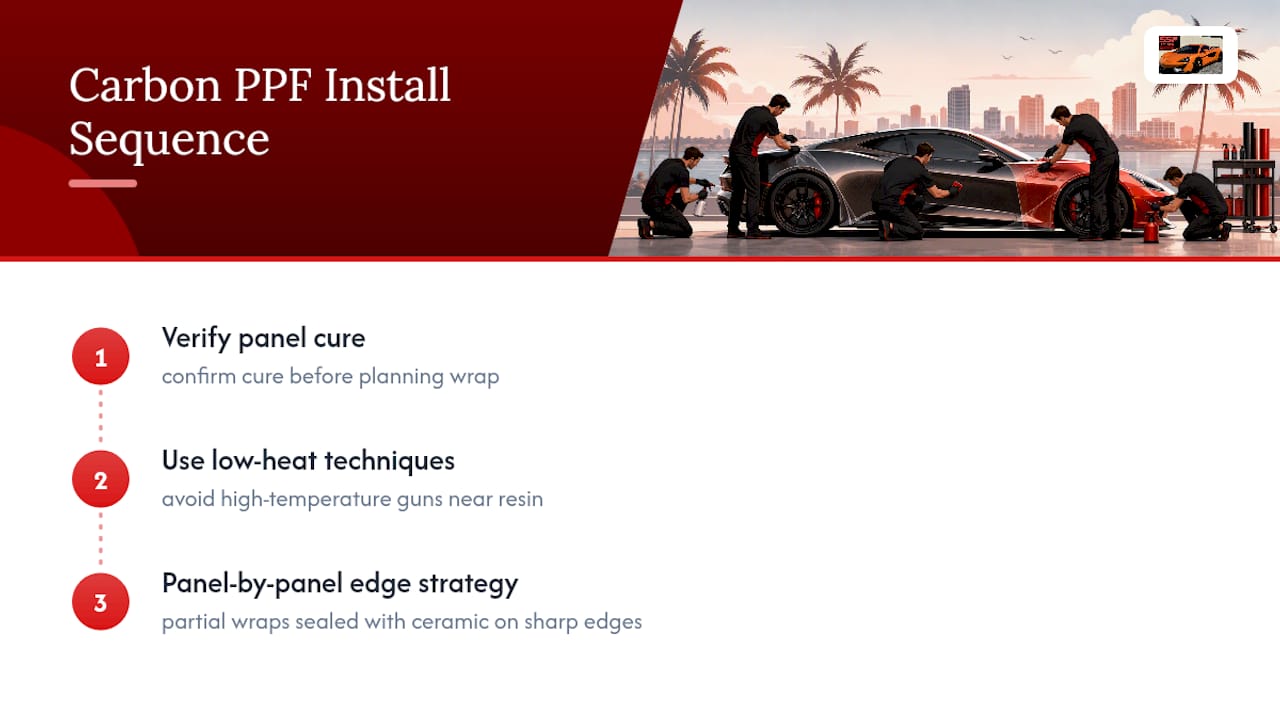
The process on carbon parts follows the sequence outlined throughout this guide: verifying a panel's cure status before committing to a wrap plan, using low-heat techniques rather than pushing high-temperature guns near resin surfaces, and choosing edge strategy panel by panel instead of applying one method across the whole vehicle. On sharper aero edges, that often means a partial wrap sealed with a ceramic top layer rather than forcing film past its stretch limit.
Clients for carbon-pattern PPF range from daily-driven performance cars getting a splitter and mirror refresh to full front-end packages on track-day builds where protection matters as much as looks. The common thread across all of them is wanting a genuinely protective film that reads as carbon at a glance and holds up under real driving conditions, not a cosmetic vinyl that peels at the first rock strike.
When Carbon-Pattern PPF Makes the Most Sense
Carbon-pattern PPF earns its place with a specific type of owner: someone who wants the visual upgrade of forged or woven carbon on a splitter, hood, or mirror cap, but isn't ready to pay for (or wait on) a genuine structural carbon part, and still wants the rock-chip and abrasion resistance a real TPU film provides over bare paint or gel coat.
If your goal is pure aesthetics on a low-contact panel and budget is the deciding factor, a well-installed vinyl wrap can hold you over for a season or two. But if the panel takes real road debris, a front splitter, a hood, rocker extensions, the self-healing and impact resistance built into carbon-pattern TPU film justifies the higher cost every time we've seen the two compared side by side after a year on the road.
The maintenance bar is lower than most owners expect going in: regular pH-neutral washes, occasional edge checks for lifting, and a ceramic top coat if you want extra gloss and easier upkeep. What actually separates a great install from a mediocre one isn't the film brand people obsess over online. It's whether the shop respected cure windows and chose the right edge strategy for your specific panels.
— Martin
Get a Quote for Carbon Fiber PPF at SSF Detail
If you're weighing carbon-pattern PPF against a vinyl wrap or an unprotected carbon part, SSF Detail gives you a path that skips the guesswork: a shop that already knows how to sequence PPF installs around carbon fiber's cure windows and heat sensitivity, rather than treating your splitter the same way it would treat a painted bumper.
Every quote we put together for a carbon-pattern PPF install specifies the exact film SKU we're using, the scope of panels covered, the expected cure window before and after install, and how your warranty gets registered once the job wraps. We also outline post-install care so you know exactly how soon you can wash the vehicle and what products to use on a fresh film surface. Many clients pair the install with our ceramic coating service for added gloss and easier long-term upkeep on the same visit.
If you're ready to see what carbon-pattern PPF looks like on your own vehicle, request a free quote for paint protection film and tell us which panels you're looking to protect. We'll walk you through film options, timeline, and pricing before anything gets scheduled.
Sources
- Carbon Fiber PPF — TeckWrap
- DYNOforged-gloss Carbon Fiber Patterned PPF | STEK USA
- PPF Then Carbon, or Carbon Then PPF? The Definitive Installation Sequence Guide – Carbonss Tuning
- Protecting Carbon Fiber: Paint Protection Film Application Guide | CyPaint
FAQ
Does Carbon Fiber Need PPF on Top?
It doesn't strictly need it, but PPF adds meaningful rock-chip and abrasion resistance that bare clear coat over carbon fiber doesn't have on its own. Most owners who invest in a carbon part or panel add PPF specifically to protect that investment from road debris.
How Much Is Carbon Fiber PPF?
Pricing scales with scope and film specs, running lowest for a single panel like a mirror cap or splitter lip and highest for full front-end or full-vehicle coverage, since complex curves and carbon-specific handling add labor time. Film thickness, brand, and warranty terms move the price within that range.
Is a Carbon Fiber Vehicle Wrap Worth It?
A vinyl carbon-look wrap costs less upfront but lacks the self-healing and impact resistance of TPU carbon-pattern PPF, so it tends to show wear faster on high-contact panels. For panels that take real road debris, PPF generally holds its appearance longer and justifies the added cost.
How Much Should a Full PPF Wrap Cost?
A full-vehicle PPF wrap sits at the higher end of PPF pricing because every panel needs individual templating and installation time, and pricing rises further when carbon-specific panels are included due to the low-heat, careful-tension technique those parts require. Getting an itemized quote that breaks down film brand, thickness, and labor is the best way to compare pricing fairly across shops.