
Ceramic tint wins on heat rejection and optical clarity in nearly every side-by-side comparison, but carbon holds its own as the value pick for owners who don't want to pay a premium. Both block roughly 99% UV, and neither interferes with GPS, radio, or cell signals. The real tradeoff isn't performance so much as budget versus how long you plan to keep the car and who's installing it.
TL;DR:
- Ceramic tint offers significantly higher infrared heat rejection, often reaching near 95%, which can result in noticeably cooler cabin temperatures during hot days.
- Both ceramic and carbon films block about 99% of UV rays, providing similar protection for skin and interior longevity, regardless of material.
- The cost difference is substantial, with ceramic installing from $300 to over $1,000 depending on vehicle size and brand, while carbon typically costs $150 to $450 for a full vehicle.
- Installer quality and certification outweigh material specifications; a skilled, authorized installer can make a ceramic film perform better than a poorly installed premium product.
- For long-term ownership or daily outdoor parking, ceramic is usually the better investment due to its durability, optical clarity, and heat rejection benefits.
Table of Contents
- Ceramic vs Carbon Tint at a Glance
- How Ceramic and Carbon Tint Actually Work
- What Heat Rejection and Clarity Look Like in Real Driving
- Cost, Warranties, and Long-Term Value
- How Each Film Looks and Ages on Your Car
- Which Tint Should You Choose for Your Situation?
- How to Check What Tint Is Already on Your Car
- Why Installation Quality Changes Everything
- The Real Question Isn't Which Film, It's Which Installer
- Get a Professional Tint Quote from SSF Detail
- Sources
- FAQ
Ceramic vs Carbon Tint at a Glance
Before you commit to a film, it helps to see the specs side by side. Prices, warranty terms, and even heat-rejection numbers shift depending on the brand and the shop doing the install, but the ranges below give you a realistic starting point.
- Heat rejection (IR): Carbon typically rejects 40 to 60% of infrared heat, while ceramic commonly lands between 60 and 80%, with some premium ceramic lines claiming figures closer to 95% in controlled tests.
- UV protection: Both materials block around 99% of UV rays, so sun damage protection for your skin and interior is essentially a wash.
- Installed price range: Carbon full-vehicle installs generally run $150 to $450; ceramic runs from $300 up past $1,000 depending on vehicle size and brand tier.
- Warranty: Carbon lines often cap coverage at 5 to 10 years, while many authorized ceramic installations carry lifetime warranties.
- Best for: Carbon suits budget-conscious owners who want a real upgrade over dyed film. Ceramic suits anyone who parks outdoors, drives an EV, or plans to keep the vehicle long enough for the price gap to pay for itself.
Two identical-sounding "ceramic" products from different brands can perform nothing alike. A film's IR rejection number is only as trustworthy as the lab test behind it, and installer skill changes the real-world result more than most buyers expect.
How Ceramic and Carbon Tint Actually Work
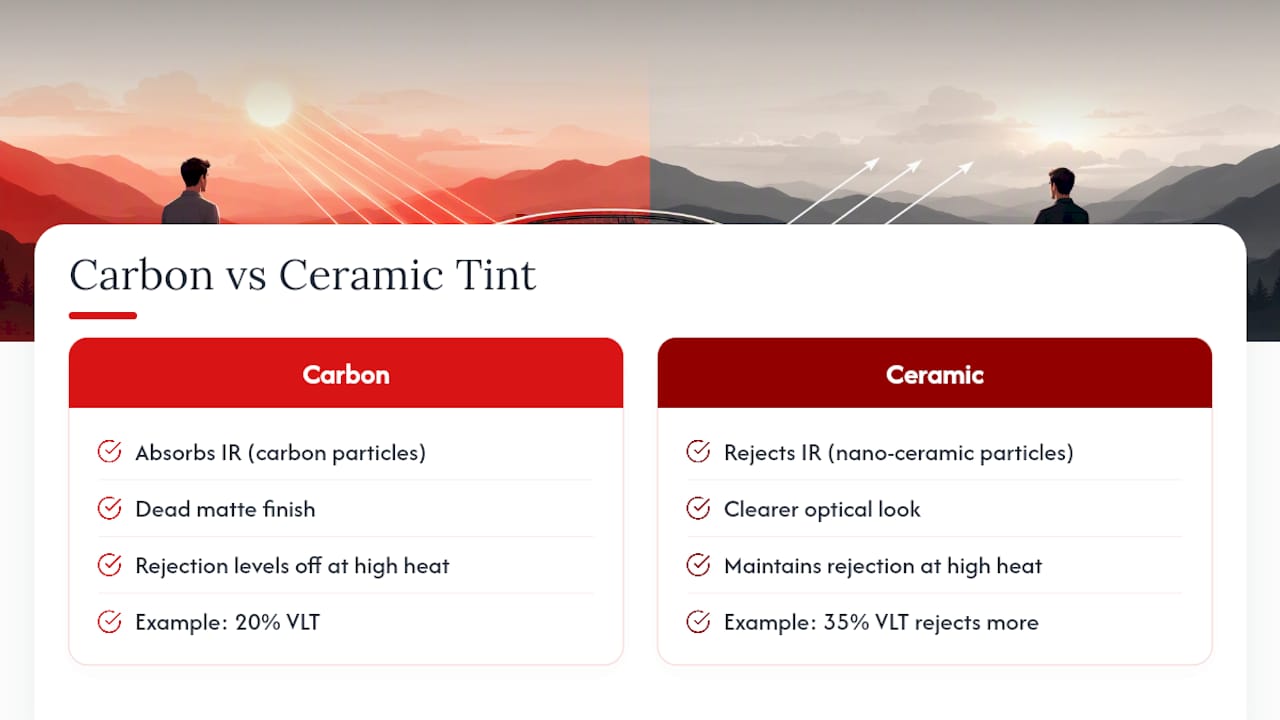
Carbon tint gets its name from microscopic carbon particles suspended in a polymer film. Those particles absorb infrared energy before it passes through the glass, which is what gives carbon its dead matte finish and noticeably better heat performance than basic dyed film. The tradeoff: carbon particles absorb heat rather than deflect it, so at very high heat loads they can approach a saturation point where added rejection levels off.
Ceramic tint takes a different approach entirely. Instead of carbon particles, it uses nano-ceramic particles that act more like a reflective filter, rejecting infrared energy before it fully transmits through the window. That's the mechanical reason ceramic tends to outperform carbon even at lighter visible light transmission (VLT) percentages. A 35% ceramic film can reject more heat than a 20% carbon film, which matters if you want a tint that stays legal in your state's VLT limits without giving up comfort.
Both materials are non-metallic. That distinction matters more than it sounds. Older metalized and hybrid films used tiny metal flakes to reflect heat, and those flakes could interfere with GPS reception, cell signal, and toll transponders. Neither carbon nor ceramic contains metal, so neither one causes signal interference, a common misconception that still shows up in tint forums and shop conversations.
Ceramic also tends to look better over time. Its optical clarity holds up longer because the ceramic particles are chemically stable and resistant to breaking down under UV exposure. Carbon holds color well too, just with a flatter, more matte look that some owners actually prefer on darker vehicles.
What Heat Rejection and Clarity Look Like in Real Driving
The heat-rejection numbers on a spec sheet only matter once you translate them into what happens inside your car on a 95-degree afternoon.
IR and heat rejection. Carbon commonly rejects 40 to 60% of infrared heat, while ceramic ranges from 60% up toward the high 80s or 90s on premium lines. That gap shows up as a measurable difference in cabin temperature. Independent installer tests and reporting have shown ceramic samples staying noticeably cooler than carbon under the same sun exposure, with real cabin temperature drops reported when switching from carbon or dyed film to ceramic.
Heat rejection reality check: A car sitting in direct sun with dyed tint can feel unbearable within minutes. Swap to ceramic and the difference isn't subtle, it's the kind of change you notice the second you open the door.
UV protection. Both materials block around 99% UV, so this isn't a deciding factor between the two. It is a reason to tint at all if you haven't yet, since UV exposure through untreated glass is what fades dashboards, cracks leather, and ages your skin on long commutes.
Optical clarity. Ceramic wins here too. Because the particles are smaller and more uniform than carbon's, ceramic film transmits light more cleanly, with less distortion and a more neutral look through the glass. Carbon's matte finish looks intentional and clean when new, but some lower-grade carbon products show slight haze earlier than a quality ceramic film.
Signal interference. Neither film contains metal, so both are safe for GPS, Bluetooth, cell reception, and any electronic toll system. If a shop tries to sell you on a "signal-safe ceramic" as a special feature over carbon, that's marketing, not a real technical advantage, since carbon has never had a signal problem to begin with.
Buyers on a tighter budget should know that carbon delivers most of the meaningful heat-rejection gains over basic dyed film at a fraction of ceramic's price. It's not a downgrade so much as a different point on the value curve.
Cost, Warranties, and Long-Term Value
Sticker price tells you almost nothing about which film actually costs less over time. A cheap ceramic quote should raise your eyebrows just as much as an expensive carbon one.
What drives the price up. Vehicle size matters most: a two-door coupe costs less to tint than a three-row SUV with a wraparound rear window. Windshield strips (where legal) add cost. Premium brand ceramic films, especially ones requiring authorized installer certification, run higher than off-brand ceramic sold at a discount shop.
- Carbon full-vehicle installs: roughly $150 to $450.
- Ceramic full-vehicle installs: generally cost more, varying by brand tier and vehicle size.
- Warranty terms: carbon commonly caps out at 5 to 10 years; many premium ceramic products carry lifetime coverage when installed by an authorized dealer.
Simple math over 5 and 10 years. Say carbon costs $350 installed with an 8-year warranty, and ceramic costs $700 with a lifetime warranty. If you keep the car five years, carbon is the cheaper choice on paper. Keep it ten years or more, and ceramic's lifetime coverage plus its slower fade rate usually closes that $350 gap, especially if you'd need to redo carbon once it starts showing UV degradation.
Pro Tip: Ask any shop quoting ceramic film for the brand name and whether they're an authorized installer for it. A rock-bottom ceramic quote often means an off-brand film with no real warranty backing, not a deal.
Installer-authorized pricing exists for a reason: premium film brands require certified installation to honor their warranty, and that certification isn't free for the shop to maintain. When a quote seems too low for genuine ceramic, it usually is.
How Each Film Looks and Ages on Your Car
Carbon has a flatter, deeper matte look that reads as intentional and clean, especially on darker paint colors. Ceramic tends to look slightly glossier and more transparent, with a truer color rendition through the glass, which some owners notice most when comparing photos taken with a phone camera in bright sun.
Neither film needs unusual care, but a few habits protect your investment either way.
- Wait the full cure time (often several days) before rolling windows down, since early manipulation can cause bubbling or edge lift.
- Use ammonia-free glass cleaner; ammonia breaks down the film's adhesive and dye layers over time.
- Skip abrasive sponges or razor blades directly on the tinted surface.
- Park in shade or a garage when possible to slow long-term fading regardless of which film you chose.
Fading and purple shift. Older dyed films are famous for turning purple as UV breaks down the dye layer. Carbon resists this well because it doesn't rely on dye pigment the same way. Ceramic resists it even better, since nano-ceramic particles are more chemically stable under prolonged UV exposure than either dye or basic carbon compounds. A car that lives outside in Florida sun will show wear faster on any film than one that spends most of its life in a garage, so your parking habits matter almost as much as which material you pick.
Which Tint Should You Choose for Your Situation?
The right film depends less on abstract specs and more on how you actually use the car.
- Daily outdoor parker. If your car bakes in a parking lot five days a week, ceramic's superior heat rejection pays for itself in comfort and reduced AC strain almost immediately. This is the clearest case for spending the extra money.
- Garaged commuter with mild exposure. If the car spends most of its life under cover and you're driving short distances, carbon gives you a real upgrade over dyed film without the ceramic premium. The heat difference matters less when the car isn't absorbing sun for hours at a time.
- EV owners. Cabin heat directly taxes range, since EVs use battery power to run the AC rather than pulling from waste engine heat. Reduced infrared transfer through ceramic tint helps HVAC systems work less to cool the cabin, which can translate into real range savings on hot days. Ceramic is the sensible choice here.
- Luxury vehicle owners. If you've already invested in ceramic coating or PPF, ceramic tint fits the same philosophy: pay once for the best material and protect the investment for the life of the car.
- Budget buyers. If cost is the deciding factor and you plan to sell or trade the car within a few years, carbon delivers real performance without the ceramic price tag. It's not a compromise so much as the right tool for a shorter ownership horizon.
Whichever film fits your situation, the choice of installer matters almost as much as the film itself. A skilled shop with clean edge work and proper cure handling will outperform a rushed install of a more expensive product. Always confirm the exact film brand your installer plans to use before you sign off on a quote, since "ceramic" alone isn't a brand name or a guarantee of quality.
How to Check What Tint Is Already on Your Car
If you bought a used car or can't remember what you had installed years ago, a few checks will usually tell you what you're working with.
Start with paperwork. Look for an installer sticker on the driver's door jamb or glove box, and check for any warranty documents from the original install. Brand labels and installer receipts are the most reliable way to confirm film type, far more reliable than a visual guess.
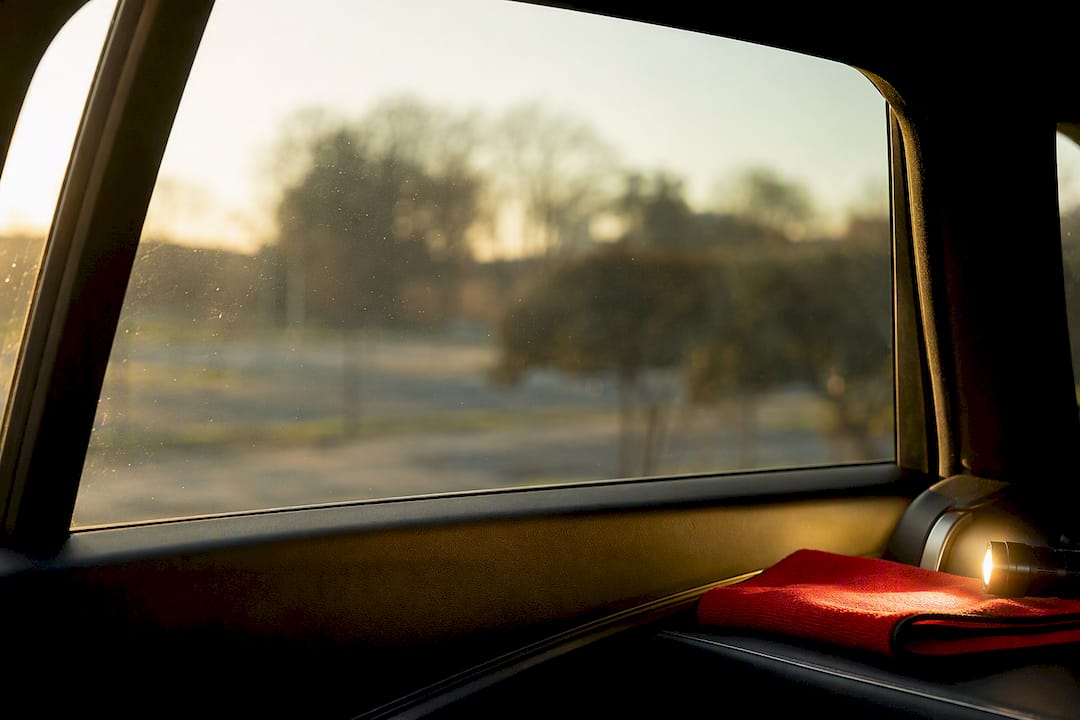
Look at the finish. Carbon has a flat, matte look with no color shift at an angle. Ceramic looks clearer and slightly glossier, with a more neutral tone when you view it from inside the car versus outside. Dyed film, by contrast, often shows a purple or blue tint once it starts aging, which neither carbon nor ceramic typically develops.
Feel isn't a reliable test, and neither is a lighter or flame test you might see suggested online. For anything that matters, like a warranty dispute or a pre-purchase inspection, an authorized dealer inspection settles the question definitively. Lab-level confirmation is rarely necessary outside of a formal warranty claim.
Why Installation Quality Changes Everything
Steven Shames has personally approved every one of the more than 1,350 vehicles that have come through SSF Detail's Boca Raton shop, and the tint bay is no exception to that standard. The film you choose matters, but how it goes on your glass matters just as much, and that's where a lot of buyers get shortchanged by shops focused on volume over precision.
Surface prep is the step most corner-cutting installers rush. Glass has to be completely clean before the film goes down, since any residue or contamination shows up permanently as a bubble or a hazy spot. Plot accuracy, how precisely the film is cut to match each window's exact curve, determines whether the edges sit flush or start peeling within a year. Edge sealing and proper squeegee technique prevent moisture from working under the film during Florida's humid summers.
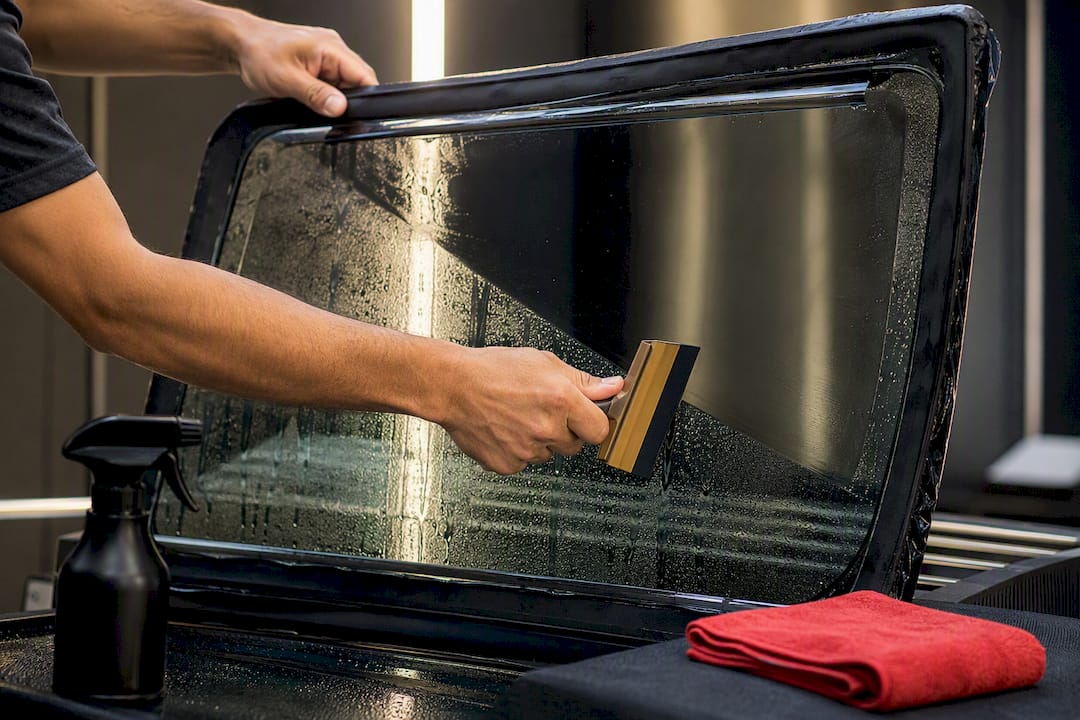
Cure handling is where a lot of otherwise good installs go wrong. Premium films require a specific cure window before the glass gets rolled down or washed, and rushing that step is one of the most common reasons a customer's tint fails early, warranty or not.
That warranty only means something if the install itself qualifies for it. Authorized installer status isn't a formality. It's the difference between a film brand honoring a lifetime warranty claim and a shop owner shrugging when your tint starts bubbling in year three. SSF Detail works with premium film options and stands behind the work performed on every vehicle that leaves the shop.
The Real Question Isn't Which Film, It's Which Installer
Most tint comparisons obsess over IR percentages and miss the bigger variable: install quality routinely outweighs a spec sheet's advantage. A carbon film installed by a careful, experienced technician will outperform a premium ceramic film rushed through by someone cutting corners on prep or cure time. That's not a popular opinion in an industry that loves to sell on numbers, but it's the honest one.
The conventional advice, buy the highest IR rejection number you can afford, isn't wrong, but it's incomplete. Spend your first dollar on finding a shop that does clean, authorized installs, and your second dollar on the film tier that fits your budget and how long you'll own the car. Ceramic remains the stronger long-term investment for anyone parking outside daily or driving an EV. Carbon remains a legitimately smart choice, not a fallback, for anyone with a shorter ownership horizon or a tighter budget.
Skip the brand debates in online forums. Ask any shop quoting you ceramic whether they're an authorized installer, and ask to see examples of their edge work up close.
— Martin
Get a Professional Tint Quote from SSF Detail
The shop installs premium window films, with warranty support backed by proper authorized installation, not just a low bid. When you book a tint appointment, expect a real inspection of your vehicle first: glass condition, current tint if any is already installed, and a walkthrough of which film tier makes sense for how you drive and park.
You'll get a straightforward quote broken down by film brand and tier, so you're comparing real options instead of guessing at a number over the phone. Warranty paperwork is typically provided with each install, helping customers prove authorized installation if needed for a claim. If you're ready to see what ceramic or carbon tint would cost for your specific vehicle, request a quote through SSF Detail's window tint page and get a straight answer instead of a sales pitch.
Sources
- Ceramic Tint vs. Carbon Tint: What's the Actual Difference? — TintGrade
- Ceramic vs carbon window tint differences — Jalopnik
- Ceramic Window Tint vs. Regular Tint: An OC Installer's Honest Guide (2026)
- How to Tell If Tint Is Ceramic: A Car Owner's Guide — The Tint Guy
FAQ
Is Ceramic Worth It Over Carbon?
For most drivers who park outside regularly or keep their car more than five years, yes. Ceramic's higher IR rejection and typically longer warranty coverage usually offset the higher upfront cost over time.
What Are the Disadvantages of Ceramic Tint?
The main drawback is price, since ceramic often costs two to three times more than carbon installed. Off-brand ceramic products sold at a steep discount can also underperform their advertised numbers, so brand verification matters.
Are Ceramic Tints Worth the Extra Money?
If you drive an EV, live somewhere hot, or plan long-term ownership, the extra cost is usually justified by better heat rejection and a longer-lasting warranty. If you're selling the car within a few years or your vehicle stays garaged most of the time, carbon often makes more financial sense.
How Can I Tell If I Have Ceramic or Carbon Tint?
Check the installer sticker on your door jamb or any warranty paperwork first, since brand labels are the most reliable identifier. Visually, carbon shows a flat matte finish with no color shift, while ceramic looks clearer and slightly glossier at an angle.