
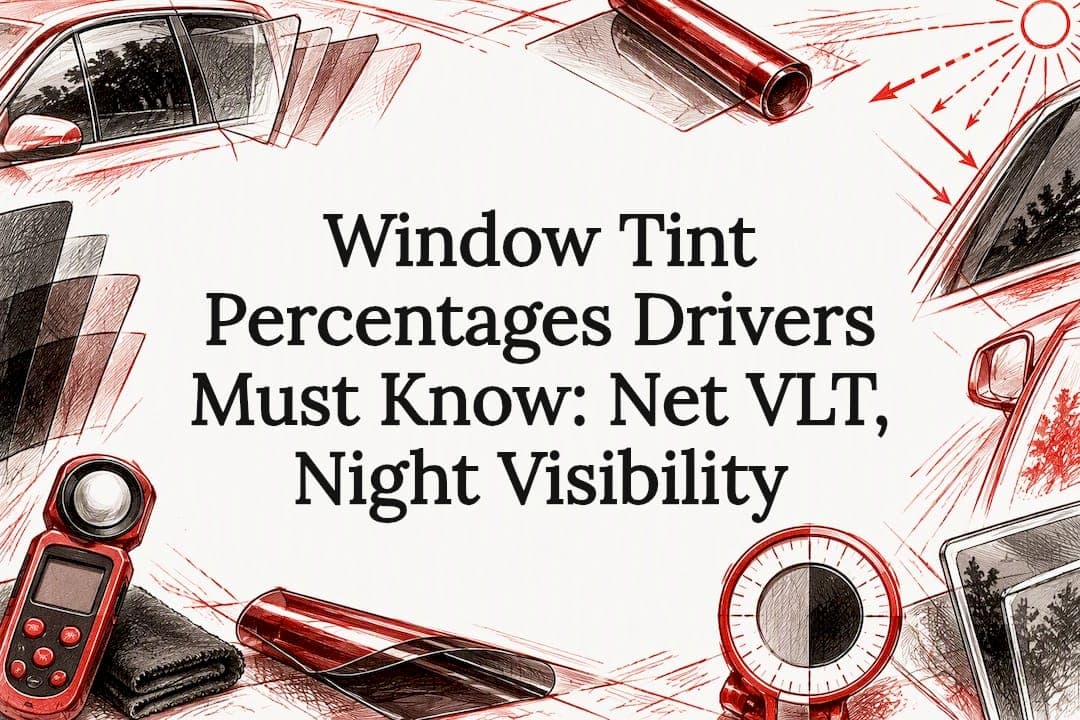
Tint percentage refers to VLT, or Visible Light Transmission: the share of light that passes through a window. Always confirm your state's specific limits and think about night driving before you commit to a shade.
TL;DR:
- Most states measure net VLT, meaning the combined light transmission of film and glass, not the film's advertised rating, affecting legal compliance.
- Darker tints like 5% or 15% VLT offer greater privacy but can impair night visibility and may be restricted on front windows by law.
- Ceramic films now effectively reject heat and UV Radiation without needing to be very dark, making them a preferred upgrade if budget allows.
- Always verify specific state laws and request a net-VLT measurement with documentation before installation to ensure legality and avoid penalties.
- Installer practices vary, so choose providers who measure net VLT, provide warranties, and supply compliance documentation along with transparent product info.
Table of Contents
- What window tint percentage (VLT) means and how net VLT is measured
- Common tint percentages and what to expect from each
- Legal limits and state variability you need to check
- How to choose the right tint percentage
- What years of tint installs have taught us
- How SSF Detail handles your tint installation
- Where to verify tint laws and safety research
- Sources
- FAQ
What window tint percentage (VLT) means and how net VLT is measured
VLT is written as a percentage because it describes how much light gets through, not how much is blocked.
Here's where it gets more technical, and where a lot of vehicle owners get tripped up. When you add aftermarket film, the number that matters legally is not the film's own rating but the combined reading of film plus glass, known as net VLT. According to the Automotive Education Guide published by the International Window Film Association, a film rated at 35% VLT on clear test glass will produce a lower net VLT once installed on factory automotive glass, which is why professional installers measure the finished window with a handheld light meter rather than relying on the film's box rating.

This distinction connects to FMVSS-205, the federal safety standard that governs glazing materials in vehicles, and it explains why two cars with the "same" film can test differently.
A few things worth keeping straight:
- VLT measures visible light only, not heat or UV rejection, which are separate ratings entirely.
- Net VLT (film plus factory glass) is what law enforcement measures, not the film's advertised percentage.
- Film technology, not just darkness, determines how much infrared heat and UV radiation actually get blocked.
Common tint percentages and what to expect from each
Each VLT level has a distinct look and a distinct trade-off. These profiles reflect how the percentages typically perform in practice, based on tint-education resources and common installer guidance.
- 5% VLT. Often called "limo tint," this is the darkest common option and provides near-total privacy, with almost no visibility into the cabin from outside. Night driving through a 5% rear window is noticeably harder, so it's typically reserved for rear windows on vehicles where front visibility isn't affected.
- 15% VLT. Still quite dark and popular for rear windows and SUVs, offering strong privacy while remaining a step lighter than 5%. Many states restrict or prohibit 15% on front-side windows.
- 20% VLT. A common middle-dark choice for rear windows and sedans, giving solid privacy with a slightly easier view out at night than 15% or 5%.
- 35% VLT. Frequently the sweet spot for front-side windows. It cuts glare and adds a moderate privacy layer while keeping night visibility close to untinted glass, which is why installers and tint guides commonly point to it as a balanced front-window choice.
- 50% VLT. A light tint that mostly reduces glare and sun exposure rather than adding privacy. It suits drivers who spend long hours behind the wheel and want comfort without changing the car's appearance much.
- 70% VLT. The lightest common option, sometimes applied to windshields as a strip or full sheet in states that allow it. It offers minimal privacy but meaningful glare reduction and UV protection.
Pro Tip: *Darker isn't always the better performer.
Keep in mind that all of this is observational guidance from installers and industry writeups, not a legal standard. Your state's rules are the only things that actually determine what's allowed on your car.
Legal limits and state variability you need to check
Tint law is set state by state, and it usually breaks down by window position: front-side windows, back-side windows, rear window, and sometimes the windshield each carry their own minimum VLT.
The net VLT concept matters here too. A state's minimum applies to the finished window, film and factory glass combined, not to the film's rating alone. This is one reason two installers can quote different film percentages for the "same legal result" on different vehicles.
Practical steps to confirm you're within the law:
- Check your state's motor vehicle department or DMV equivalent for the current window tint statute before you install anything.
- Ask your installer for a net-VLT reading on your specific glass, not just the film's box rating.
- Keep a copy of the film's specification sheet and your installation receipt in the glove box.
Some states also offer medical exemptions for drivers who need darker tint than the standard limit allows. Florida's process is a useful example: qualifying drivers can apply for the TL-55 sunscreening exemption certificate, which requires physician certification and is processed through the Florida Department of Highway Safety and Motor Vehicles for vehicles titled and registered in the state. Other states run comparable medical review programs, so check your own state's motor vehicle authority if you have a qualifying condition.
How to choose the right tint percentage
Picking a percentage comes down to five practical questions: how much you drive at night, how much privacy you want, what the vehicle is used for, what your state actually allows, and whether your installer uses film technology that performs well without going dark.
- Look up your state's front, rear, and windshield VLT minimums before you fall in love with a shade.
- View sample film swatches on your own vehicle in daylight and after dark, since lighting changes how a percentage looks and feels.
- Ask for a net-VLT measurement and a written product specification sheet for the exact film going on your glass.
- Get a warranty in writing and keep your compliance paperwork with your registration.
Pro Tip: If a shop won't hand you a spec sheet or measure net VLT before installation, treat that as a warning sign, not a shortcut.
Watch for installers who push a darker film than your state permits just because "everyone does it," or who can't produce documentation on request. Those are the two clearest signs you're dealing with a shop that cuts corners.
What years of tint installs have taught us
What's changed more than the percentages is the film itself: ceramic options now reject meaningful heat and UV without pushing the cabin darker than a driver wants, which is why we steer clients toward ceramic over dyed film whenever the budget allows. Whoever installs your tint should show you samples on your actual car, pull a net-VLT reading before you sign off, and hand you a warranty and compliance sheet, not just a receipt.
— Martin
How SSF Detail handles your tint installation
Choosing a percentage is only half the job. The other half is making sure it's measured correctly, installed cleanly, and documented so you're not guessing about compliance later. Our Full Car Tint service includes film options with a net-VLT reading on your actual glass, so the number on paper matches what's legally on your car.
Here's what you get when you book with us:
- A sample viewing on your vehicle before installation, in daylight and after dark.
- A written specification sheet for the film going on your glass, plus a documented net-VLT reading.
- A warranty and compliance paperwork you can keep with your registration.
If you're weighing ceramic against dyed film, the breakdown of tint brands covers the material differences in plain terms. When you're ready, request a quote through the window tint service page to learn about percentages that fit your car and your state's rules.
Where to verify tint laws and safety research
- Your state motor vehicle department, such as Florida's FLHSMV, for current legal limits.
- IIHS headlight and visibility research on how tint interacts with nighttime driving safety.
- The Automotive Education Guide from the International Window Film Association for VLT and measurement standards.
Sources
- TL-55 Sunscreening Medical Exemption Certificate
- IIHS research: headlights and visibility
- Automotive Education Guide
- Window Tint Percentages Explained
FAQ
Is 20% tint legal in Texas?
Check your state motor vehicle department's current tint chart before installing, since rules change and vary by vehicle type.
Is 35% or 20% tint darker?
A 35% film is generally considered a lighter, more visibility-friendly option than 20%.
Is 5% tint legal in California?
Check your state's motor vehicle authority directly, since front-window limits are typically stricter than rear-window limits.
Is 15% tint legal in Pennsylvania?
Confirm the current limit with your state motor vehicle department before installation, as enforcement is based on net VLT measured on the finished window.