
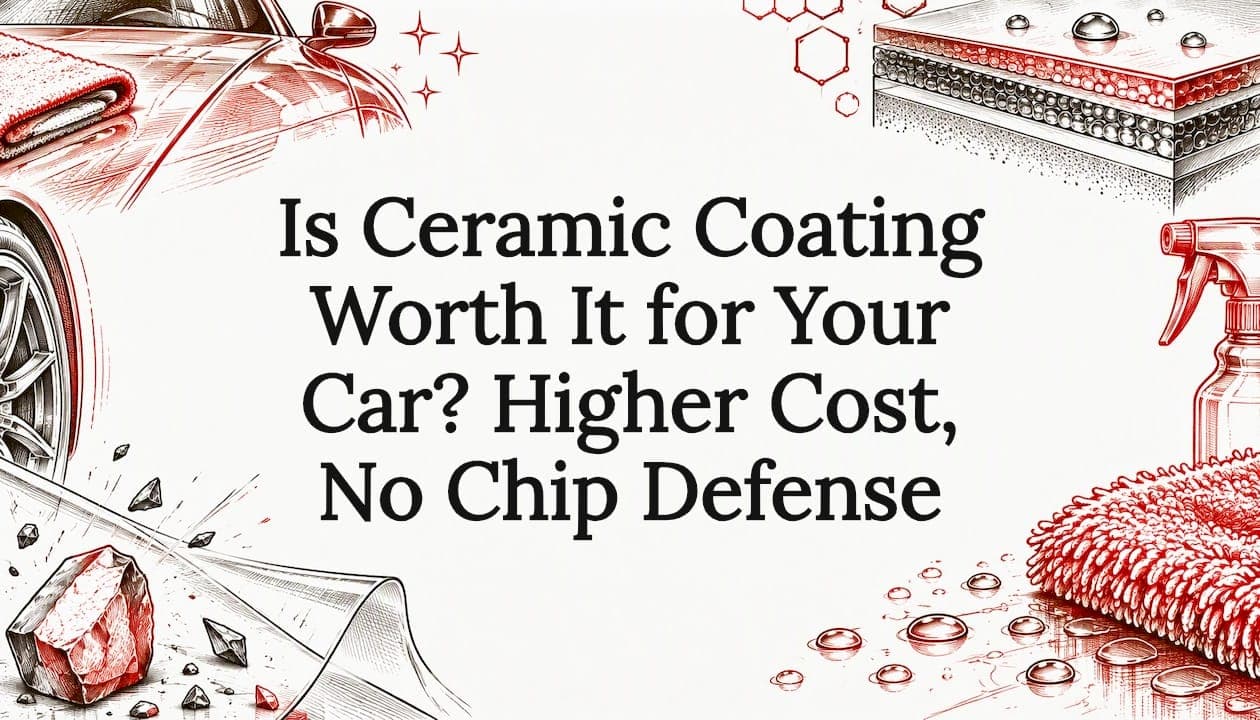
For many owners of newer or higher-value cars who want gloss and easier washing, ceramic coating may be worth the money, provided it's applied over properly prepped paint. The tradeoffs are real: a higher upfront cost than waxing, and no defense against rock chips. If impact protection is your priority, paint protection film is the right tool, and ceramic coating is the right tool for everything else.
TL;DR:
- Packages start at $1,149, while larger vehicles, rough paint, and added correction raise quotes; over three to five years, coating can rival repeated waxing.
- Correctly applied professional coatings can last upward of five years, while retail kits are shorter lived; product, preparation, and washing habits all affect durability.
- Paint correction and decontamination must happen before coating, because cured product can seal in swirls, haze, and contamination that later require polishing to remove.
- Skip standard coatings on matte or satin finishes, and inspect antique cars with original or thin paint first; failing clear coat may make correction uneconomical.
- Follow the installer’s cure instructions, avoid brush washes and harsh cleaners, and wash gently to protect the coating and preserve warranty coverage.
Table of Contents
- What does ceramic coating actually do for your paint?
- What won't ceramic coating do? Limits and myths worth knowing
- How much does ceramic coating cost compared to waxing and DIY kits?
- Should you coat your car yourself or hire a professional?
- How long does ceramic coating last, and what happens while it cures?
- Which cars and owners get the most out of ceramic coating?
- What does a good maintenance routine for a coated car look like?
- Ceramic coating, PPF, or sealant: which protection fits your car?
- Is ceramic coating right for you? A decision checklist
- Our perspective: how we recommend and install coatings
- Get a quote for professional ceramic coating and paint correction
- FAQ
- Sources
What does ceramic coating actually do for your paint?
A ceramic coating is a liquid treatment that bonds to your clear coat and cures into a thin, hard layer. USA Today explains that coatings use nanoparticles to bond with paint, producing hydrophobic behavior and a deep gloss, while noting they don't make paint invulnerable. That distinction shapes everything else in this article.
What you notice day to day is mostly about water and dirt. Beads of water roll off instead of sheeting and drying in place, and grime has a harder time gripping the surface. Here's what owners typically see:
- Easier washing: dirt releases with less friction, so you touch the paint less and introduce fewer swirls.
- Fewer water spots: the coating's hydrophobic behavior helps water run off.
- Easier cleaning: grime and contaminants can be easier to remove.
- Gloss: coatings can help maintain a deep gloss.
- Less frequent protection chores: you're not re-waxing every few weeks.
That last point matters more than it sounds. Consumer Reports notes that waxes and sealants work but wear off in weeks to months, and that regular cleaning is the most important protection of all. A coating doesn't replace washing. It makes washing faster and more effective.
What a coating won't do is stop a stone at highway speed. It's a chemical layer, not a physical one. For that, you want film, which we cover later in this article.

What won't ceramic coating do? Limits and myths worth knowing
Setting realistic expectations is the fastest way to avoid regret. A coating is a strong chemical shield with clear boundaries.
- It won't stop rock chips or deep scratches. A chemical coating is not a physical impact-protection layer.
- It can seal in existing flaws. If swirl marks, haze, or contamination are on the paint when the coating cures, they're locked under it. Consumer Reports' detailing guidance stresses hand-washing and proper prep products such as automotive soap and clay bars before any protective layer goes on, because skipping prep risks sealing contaminants into the paint.
- It isn't set-and-forget. Abrasive wash tools and harsh soaps wear the layer down early, and coated cars still need regular, gentle washing.
- It doesn't last forever. It's semi-permanent, which is not the same as permanent.
Two myths come up constantly. The first is "scratch-proof." A coating adds some surface hardness, but a key or a gritty wash mitt will still mark it. The second is "permanent gloss." Gloss lasts as long as the coating does, and it fades as the layer degrades or gets clogged with road film.
Pro Tip: Judge a coating by how it behaves after normal washing, not by how it looks on delivery day. Water behavior and how easily dirt releases tell you more than shine does.
Jalopnik's real-world review lands in a similar place: a professionally applied coating can be worth it for owners serious about protecting paint, provided it goes on correctly and gets proper upkeep. We agree with that framing, and it's the reason we spend as much time talking about prep and maintenance as we do about the coating itself.
How much does ceramic coating cost compared to waxing and DIY kits?
Price tracks effort, not just product. The coating itself is a small part of a professional bill. Most of the cost is labor: washing, decontamination, and paint correction, which is the polishing that removes swirls and defects before anything gets sealed in. A larger vehicle, rougher paint, and a longer warranty all push the number up.
Here's how the options generally stack up:
- Professional install: the highest upfront cost, the most concentrated products, and the most thorough prep.
- Retail kits and spray coatings: much cheaper and easier to apply, but thinner and shorter-lived. Car and Driver's guide to sealants notes that retail spray ceramic products use SiO2 chemistry and deliver hydrophobic benefits and easier cleaning, but typically produce thinner, shorter-lived protection than concentrated professional coatings.
- Wax or sealant: the lowest cost per application, but you repeat it often.
For reference, our own Basic Ceramic package starts at $1,149, Advanced Graphene at $1,599, and Pro Borophene at $2,249. We inspect every car before quoting.
Car and Driver found that professional-grade coatings are more concentrated and longer lasting than retail kits, and that professional applications often require extensive prep and can last upward of five years when applied correctly. That longevity gap is what justifies the higher price.
The cost-over-time view
Looking only at the sticker price misleads people. Professional detailers recommend a cost-over-time comparison: a coating costs more up front than a wax, but across roughly three to five years it can land in the same range as repeatedly paying for professional wax or sealant services. Say you pay for protection a couple of times each year, and the coating replaces most of that work. The gap narrows quickly, and you also spend fewer weekends buffing.
Where a coating becomes clearly cost-effective:
- You plan to keep the car for several years.
- You'd otherwise pay for or perform frequent protection.
- Your car sits outside in strong sun, or it's regularly exposed to salt, bugs, and road film.
One honest caveat: appraisers and dealers generally don't add a dollar line item for ceramic coating when valuing a car. The financial benefit shows up as avoided loss, meaning paint that's in better condition when you sell. Think of it as preservation, not a resale bonus.
Should you coat your car yourself or hire a professional?
Both routes can work, but they're different jobs. The coating is the easy last step. The hard part is everything before it, because whatever is on your paint when the coating cures is staying there.
Here's what a careful application involves, whoever does it:
- Wash and decontaminate. A hand wash, then a clay bar or equivalent to pull bonded contaminants out of the paint.
- Correct the paint. Polishing removes swirls and haze. Practitioner-level guidance such as Car and Driver's restoration-expert walkthrough describes clay, polishing, and the right compounds and pads as standard preparation for a showroom finish.
- Wipe down the surface. Residual oils from polishing must be removed so the coating bonds.
- Apply in controlled sections. Follow the product instructions to avoid letting it set before you level it.
- Manage the cure. Temperature, humidity, and dust all affect how the layer sets.
For a DIY owner, that means time, a good light, polishing tools, and the skill to use them without burning through clear coat. A mistake is expensive: once a coating cures over a flaw or a high spot, fixing it often means polishing it all back off.
Durability and warranty also differ. Retail kits are a budget-friendly, shorter-lived option, and the warranty, if any, is limited. A professional install typically includes a longer service life and follow-up guidance on maintenance. A pro is worth the price when the car is new or high-value, the paint needs correction, or you simply want the result done once and done right.
How long does ceramic coating last, and what happens while it cures?
Lifespan depends on the product, the prep, and how you care for the car. Retail kits last a shorter time than professional coatings, and professional-grade coatings applied correctly can last upward of five years, according to Car and Driver's testing. USA Today adds that lifespan varies by product and application, so treat any single number as a ceiling for good conditions, not a promise.
Curing is the part owners overlook. Follow the product or installer guidance on when the coating is ready for exposure to water, chemicals, and washing.
What to do and avoid right after application:
- Keep the car dry and, ideally, indoors for the period specified by the product or installer.
- Skip automatic brush washes until the coating has fully cured.
- Avoid harsh chemicals and strong degreasers at all times.
- Remove bird droppings and sap gently with a soft cloth and plenty of lubrication.
- Hold off on wax or sealant over the top unless your installer recommends a specific maintenance product.
After that, habits decide the lifespan. Abrasive wash tools, high-alkaline soaps, and neglected contamination shorten it. Skipping recommended maintenance can also affect warranty coverage, so read the terms before you buy.
Consumer Reports' testing and expert commentary found that waxes and sealants wear off in weeks to months, which is the baseline a multi-year coating is measured against.
Which cars and owners get the most out of ceramic coating?
Coating pays off most when the paint is worth protecting and the owner wants to spend less time on upkeep. Here's who tends to benefit most:
- New and nearly new vehicles: fresh paint needs minimal correction, so the coating locks in a clean surface.
- Higher-value and enthusiast cars: the cost is small relative to the value you're preserving.
- Show cars: the extra gloss and easy cleanup help at events.
- Cars parked outside or driven daily: sun, bugs, bird droppings, and road film are where coatings earn their keep.
- Frequent washers: if you already wash often, a coating makes each wash quicker and gentler on paint.
And when might you skip it?
- Older cars with poor paint: failing clear coat is a problem a coating can't fix, and correcting it first may cost more than the car warrants.
- Tight budgets: a good wax or sealant, reapplied on schedule, is a legitimate choice.
- Owners who enjoy waxing: if the ritual is the point, a coating removes it.
A few special cases are worth a conversation before you commit. Matte and satin finishes need products designed not to add gloss, so don't use a standard coating on them. Antique and classic cars with original or thin paint call for an inspection first. Fleet vehicles can benefit from coatings, though the economics depend on how many vehicles you run and how they're cleaned.
What does a good maintenance routine for a coated car look like?
The routine is simple, and consistency matters more than any single product. Gentle washing preserves the coating's water behavior and slows swirl marks.
- Rinse first. A thorough pre-rinse lifts loose grit so it doesn't drag across the paint.
- Use a pH-neutral automotive shampoo. Dish soap and strong alkaline cleaners strip protection.
- Wash with the two-bucket method. One bucket for soapy water, one for rinsing your mitt, so dirt doesn't go back on the car.
- Use clean microfiber mitts. Wash top to bottom, saving the dirtiest lower panels for last.
- Dry with a plush microfiber towel or a forced-air blower to avoid water spots.
- Add a maintenance spray as recommended. Some coatings benefit from a compatible topper to refresh slickness.
Wash on a schedule that matches your conditions. Heavy-use or high-exposure environments may call for more frequent washing, while garaged cars may need less frequent washing. Where possible, avoid automatic brush washes, because abrasive brushes can mar even a coated surface.
For contaminants, prompt gentle cleaning is sensible. Soften bird droppings and tree sap with water, lift them gently with a microfiber, and avoid scrubbing dry.
Pro Tip: Keep a bottle of waterless wash or quick detailer and a clean microfiber in the trunk. Promptly and gently removing bird droppings can help protect a coated finish.
When water stops beading and sheeting well after a proper wash, or the surface feels rough despite clay-free washing, it's time for a professional inspection. A decontamination wash may restore performance, or the coating may be ready for a refresh.
Ceramic coating, PPF, or sealant: which protection fits your car?
These products solve different problems, and the best choice often combines them. Think in terms of the threat you're guarding against.
- Paint protection film (PPF): a physical urethane layer that absorbs stone chips and light scratches. It's the right choice for front ends, rocker panels, and any area that takes impact. See our paint protection film options for coverage levels.
- Ceramic coating: a chemical layer that can provide hydrophobic behavior and gloss. It's not for impact protection.
- Ceramic over PPF: coating the film adds slickness and easier maintenance, since film can hold onto dirt more than bare paint does. Owners who want both impact defense and easy washing often choose this pairing.
- Wax or sealant: the lowest-cost, shortest-lived option. Consumer Reports makes the point that they work, just not for long. For a car you'll sell soon or an older vehicle, they can be entirely adequate.
If you're comparing durability in a hot, sunny, salty climate, our own breakdown of ceramic coating versus wax versus paint sealant walks through how each holds up.
A practical rule: if rock chips worry you more than water spots, start with film. If you drive mostly on clean roads and want shine and easy cleaning, coating alone is plenty. If you want both, plan them together so the sequencing is right.
Is ceramic coating right for you? A decision checklist
Run through these questions honestly before you spend anything:
- Vehicle value: is the car worth protecting for years to come?
- Paint condition: is it healthy enough that correction is reasonable, or is it failing?
- Exposure: does the car live outside in sun, salt, or heavy contamination?
- Budget: can you cover the upfront cost without cutting corners on prep?
- Maintenance willingness: will you wash gently and on schedule?
If you're going ahead, start with paint correction, compare warranty terms in writing, and choose either a professional installer or a high-quality retail kit with clear expectations about its shorter life. If you're skipping it, stay on a regular wax or sealant schedule and keep washing properly, since regular cleaning is the real protection.
| Situation | Best fit | Why |
|---|---|---|
| New or high-value car, kept for years | Professional ceramic coating | Professional applications can offer longer-lasting protection, with proper prep |
| Rock-chip risk on highways | Paint protection film | A physical layer intended to help protect against impacts |
| Tight budget, enjoys car care | Retail kit or sealant | Lower cost, shorter life |
| Older car with failing paint | Wax or sealant | A coating may not be suitable for paint in poor condition |
Our perspective: how we recommend and install coatings
We don't recommend a coating to every car that rolls in. Steven Shames, our owner, personally inspects and approves every vehicle we service, and that inspection decides the plan. Sometimes the answer is a coating after paint correction. Sometimes it's film on the front end and a coating over the rest. Occasionally it's a maintenance detail and a sealant, because that's what the paint actually needs.
Here's the opinion we've formed after servicing many cars: the coating is the least important part of a coating job. Owners fixate on product names and warranty years, but results are decided by the hours of prep before the product touches the car, and by how the car is washed afterward. A premium coating over rushed prep underperforms a modest one over paint that's been properly corrected. If a shop can't tell you how it prepares paint, that tells you more than the brand on the bottle.
On our end, you can expect an inspection first, correction matched to the paint's condition, a controlled application, and clear aftercare guidance covering the cure window and wash routine. We also build personalized plans, including maintenance memberships, so the finish stays sharp. If you'd like to see how we explain coatings to customers, our about ceramic coating page covers it, and we're happy to share transformation stories if you ask.
— Martin
Get a quote for professional ceramic coating and paint correction
If you've decided a coating makes sense for your car, we'd like to be the shop that does it. Our work starts with an owner-approved inspection, so you know the real condition of your paint before you commit.
Here's what we offer for protecting and preparing your car:
- Basic Ceramic: an option for owners considering ceramic coating.
- Advanced Graphene: another coating option.
- Pro Borophene: our premium coating option.
- Full Detail PLUS and Full Detail: thorough interior and exterior cleaning and paint prep before coating.
- Maintenance plans: options are available to help keep your finish looking right.
Booking is simple. We inspect the car, agree on prep, schedule the work, and walk you through cure and washing guidance. Request a quote on our ceramic coating page and we'll tell you honestly what your car needs.
FAQ
Is there a downside to ceramic coating?
The main downsides are the upfront cost and the fact that it doesn't stop rock chips or deep scratches. It also needs gentle washing, and it can lock in flaws if the paint isn't prepped well. Jalopnik's real-world review reaches a similar conclusion: it's worth it when applied properly and maintained.
How much does a multi-year ceramic coating cost?
It depends on vehicle size, paint condition, and the product's durability, since correction is a major part of the labor. Our packages start at $1,149 for Basic Ceramic, $1,599 for Advanced Graphene, and $2,249 for Pro Borophene, and we quote after inspecting your car.
Is ceramic coating really necessary?
No, it isn't necessary, and regular washing remains the most important protection. Consumer Reports notes that many car-care extras are largely cosmetic. A coating is worth it mainly if you want longer-lasting gloss and easier cleaning with less frequent waxing.
Does ceramic coating protect against rock chips?
No. A coating is a thin chemical layer and can't absorb impact. For chip protection, paint protection film is the right option, and some owners layer a coating over it for easier maintenance.
Sources
- Are Car-Wash Extras Worth It? - Consumer Reports
- Is Ceramic Coating Worth It? Here's How It Holds Up In The Real World
- Does ceramic coating your car really protect its paint? Here's how it works