
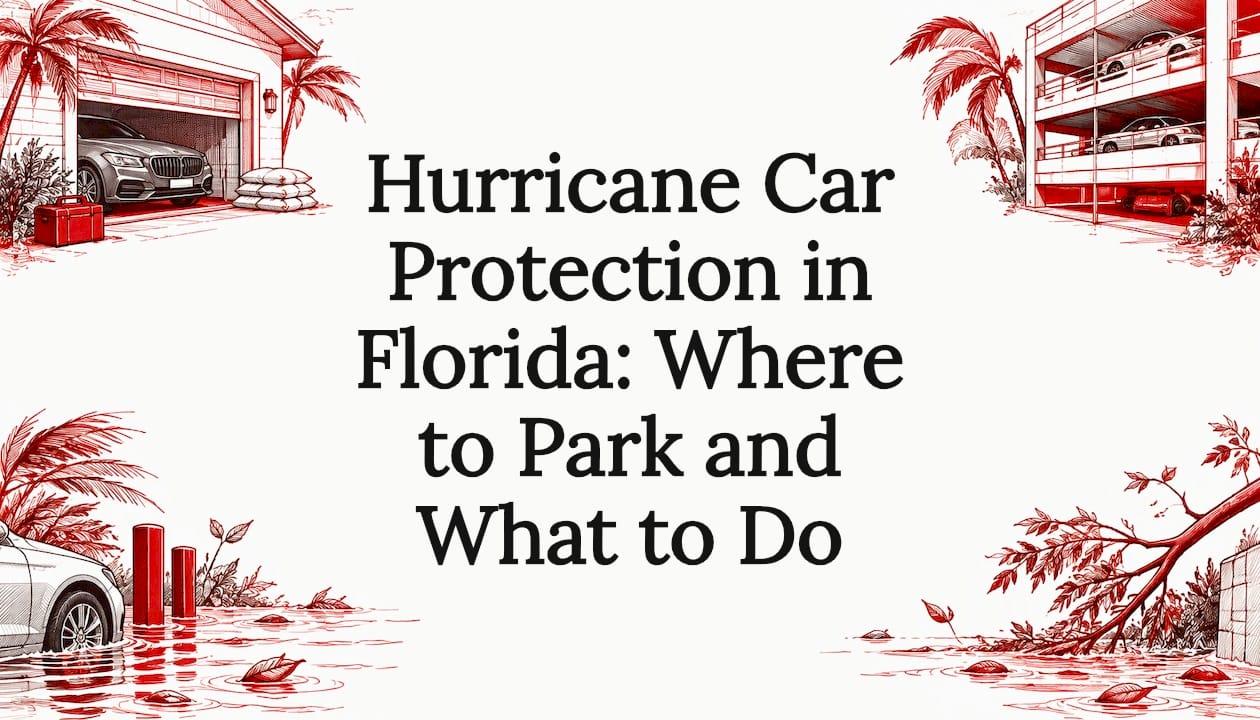
The best hurricane protection for a car is where you put it and when you put it there. Move it out of any flood zone, get it under a solid roof, away from trees and power lines, and do that 24 hours before landfall, not 2. Insurance paperwork, a full tank and photos come first, and the paint gets proper care once the storm has passed. This guide gives the full routine for Palm Beach County owners with a car worth protecting, including what to do afterward, when salt, debris and moisture can do their slow damage to the finish.
TL;DR
- Flood water is the biggest threat to a parked car. Move it to high ground or an upper level of a sturdy garage, never a low-lying lot or a street that floods.
- Start early: service, tires and battery in the weeks before, a full tank and insurance photos at 72 hours, parking at 24 hours.
- A cover is a second layer, not a shelter. It only helps if it is the right size, fitted snugly, and used inside a garage or beside a sturdy structure.
- Only optional comprehensive coverage pays for storm and flood damage, so confirm yours before a storm is in the forecast.
- After the storm, wash off salt, grit and debris quickly. Our team in Boca Raton can do it at your home or at our shop.
Table of Contents
- Know when to prepare
- Where to store your car during a hurricane
- Car covers: when they help and when they do not
- Flood water: the rule that protects you, not just the car
- Electric and hybrid vehicles
- Insurance and documents: do this before the storm
- After the storm: what the paint needs
- Our perspective
- FAQ
- Sources
Know when to prepare
Florida's hurricane season runs June 1 to November 30, with the busiest stretch from mid-August through September. Late-season storms can still form in the Caribbean in November, so a car that is "safe for the year" in October is not necessarily safe in November.
The simplest way to avoid a last-minute scramble is to work in stages. Kelley Blue Book's hurricane checklist lays out a timeline that fits a Florida owner well:
| When | What to do |
|---|---|
| About 60 days before the season | Service the cooling system and oil, and check for open recalls |
| 2 to 4 weeks out | Test the battery, check and rotate tires, make sure the spare is usable |
| 72 hours out | Fill the tank or charge the EV, photograph the car from several sides for insurance |
| 24 hours out | Move the car to high ground or a garage, unplug the EV charger, sandbag the garage threshold |
Two details matter more than they look. First, fuel: gas pumps do not work without electricity, so a full tank well in advance keeps your evacuation options open. Second, the photos. Timestamped images of every side, the roof, the wheels and the interior give your insurer a clean before-and-after record if the car is damaged. Do this at 72 hours, while the car is still clean and the light is good.
A small emergency kit belongs in the car as well: booster cables, a tire repair kit, a flashlight, a shovel and traction mats, as Chubb suggests. If you are evacuating, Ready.gov also recommends keeping medication and other essentials in a go bag or the trunk.
Where to store your car during a hurricane
Three threats decide where a car should sit: rising water, wind-blown debris, and falling trees or limbs. A good spot beats all three. The research from insurers and automotive groups points to the same order of preference.
1. An interior garage that you have prepared
A garage is the first choice if it is not in a flood-prone spot and the door is solid. AAA's hurricane guidance for garage storage is specific:
- Cover garage windows.
- Lock the door's secure latch and detach the automatic opener so it does not break when the latched door is pushed in.
- Pull the car close to the back wall in case the door is blown inward.
- Close and secure all car windows and the sunroof.
Kelley Blue Book adds that you should board up exterior garage windows and tie down loose items so they cannot become projectiles inside the garage. Chubb notes that parking close to the garage door can help keep it from buckling inward. The two tips pull in opposite directions, so judge your own garage: a strong, properly latched door with a car a few feet back from it is the usual compromise.
If the garage is on the ground floor of a home in a mapped flood zone, treat it as a flood risk and sandbag the threshold, or choose a higher location.
2. A sturdy public or private parking structure
If you live in a condo, a townhome or a house with a vulnerable garage, a multi-level parking structure is a strong option. Dairyland Insurance recommends garages where the upper levels add flood protection, and says to avoid parking near trees, power lines, light poles and signs. Go to an upper level, away from ramps where water can pour in and away from open sides facing the wind.
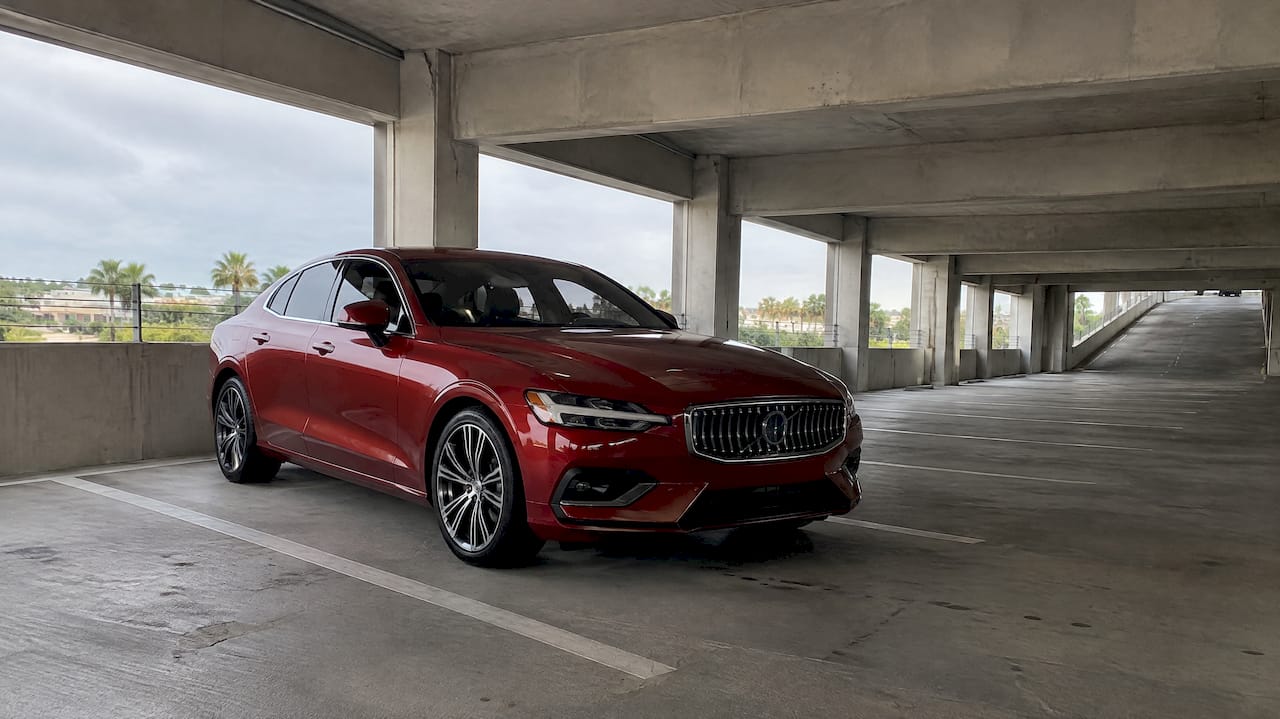
Some cities open garages to residents before a storm. Miami's parking authority, for instance, runs a hurricane parking program, and Palm Beach County residents should check their own city or county emergency pages as a storm approaches. Rules, locations and any fees change, so confirm them each season rather than relying on last year's arrangements.
3. Outdoors, as a last resort
When there is no garage, the goal is to reduce exposure. Kelley Blue Book says to park on the highest ground available or along the side of a sturdy structure to shield the car from wind and projectiles, and to bring loose objects such as lawn furniture and inflatables inside. GEICO adds that you should move the car away from trees or other objects that could fall and keep it clear of low-lying areas.
Walk your own property and look up. A large tree that has never bothered you in normal weather becomes a hazard in 100 mph gusts. A car parked in the open driveway, 30 feet from the trunk, is often safer than one tucked beside the garage under overhanging limbs.
Car covers: when they help and when they do not
Owners ask whether to cover the car. The honest answer is that a cover is an added layer, not a shield. It cannot stop a limb, and an ordinary cover in open wind tends to rip loose or flap against the paint.
Where it earns its place:
- Inside a prepared garage. AAA suggests an extra protection layer over the car with windows and sunroof closed. A padded cover or thick blankets, as Kelley Blue Book describes, buffer against debris if the garage is breached.
- Outdoors beside a sturdy structure. Kelley Blue Book recommends a heavy-duty cover larger than the vehicle with seat cushions inside for extra buffering. Chubb says a tight-fitting cover may offer some protection when there is no garage.
Two practical cautions apply to using a cover safely. Put it on over a clean car, because dust and grit trapped underneath can mark paint when wind moves the fabric. And take it off soon after the storm. A car that stays covered for several days in a humid Florida garage can trap moisture against the paint, so lift the cover once the weather has passed and let the car breathe.
Flood water: the rule that protects you, not just the car
Most vehicle losses in hurricanes come from water. The numbers are stark. FEMA's Ready.gov hurricane page warns that six inches of fast-moving water can knock a person down and one foot of moving water can sweep a vehicle away. Its message is simple: do not walk, swim or drive through flood water. Turn around.
A few more safety points to keep in mind:
- Deep water can hide debris that damages a vehicle, and if you become trapped in rising water, abandon the car for higher ground and call 911 if you cannot get out safely.
- Downed power lines can electrify flood water. First Florida's guidance is to never exit your vehicle near a downed power line.
- After a storm, treat an intersection with dead signals as a multi-way stop.
None of this changes with the price of the car. The most expensive vehicle on the street is just as exposed to a flooded road as any other, which is why the decision to move early matters more than any product.
Electric and hybrid vehicles
If you drive an EV, ask yourself what happens if water reaches the battery pack. Ford's submersion guidance says to move the vehicle to higher ground and charge it fully before a flood. If it cannot be moved, unplug the charger, reduce the state of charge, and raise the car on a jack stand or ramp so the high-voltage battery sits above the potential flood line. After submersion, Ford says to treat it as an accident, not operate it until a technician inspects it, and tow it at least 50 feet from structures. Other manufacturers publish their own guidance, so check your owner's manual or brand support page before the season.
Insurance and documents: do this before the storm
Florida does not require comprehensive coverage, and it is the only part of a standard policy that pays for storm and flood damage to your own car. The state's required personal injury protection and property damage liability do not. A Florida insurance explainer notes that insurers commonly stop writing new or increased coverage once a storm nears the state, so the time to check is well before the cone appears on the forecast.
What to confirm with your agent:
- You have comprehensive coverage. It is optional unless a lienholder requires it, which is usually the case on a leased or financed car. State insurance departments describe it as covering wind and flood damage, while liability-only coverage does not cover flooding.
- Your deductible. Deductibles usually run between $100 and $1,000, so know your number.
- How a total loss is settled. The payout is generally based on actual cash value just before the loss, minus the deductible. For a well-kept luxury or specialty car, the photos you took at 72 hours help document its condition.
- Where the documents are. Ready.gov advises keeping insurance policies copied in a secure digital space, and Chubb suggests a copy of the auto policy in a waterproof container. GEICO also advises securing your title and registration to speed up a claim.
For a vehicle with specialized value, such as a classic, exotic or heavily modified car, speak with your insurance agent about how it is valued under your policy. That is the right professional for that question.
After the storm: what the paint needs
Once roads are safe, the car's finish still has work to do. Hurricane air carries salt, grit and organic debris, and rain driven sideways pushes it into every seam. Left alone, leaves, tree sap and salt residue sit on the clear coat in the Florida heat. The fix is not complicated: rinse the car gently, then wash and decontaminate it properly instead of dragging grit across the paint with a dry cloth.
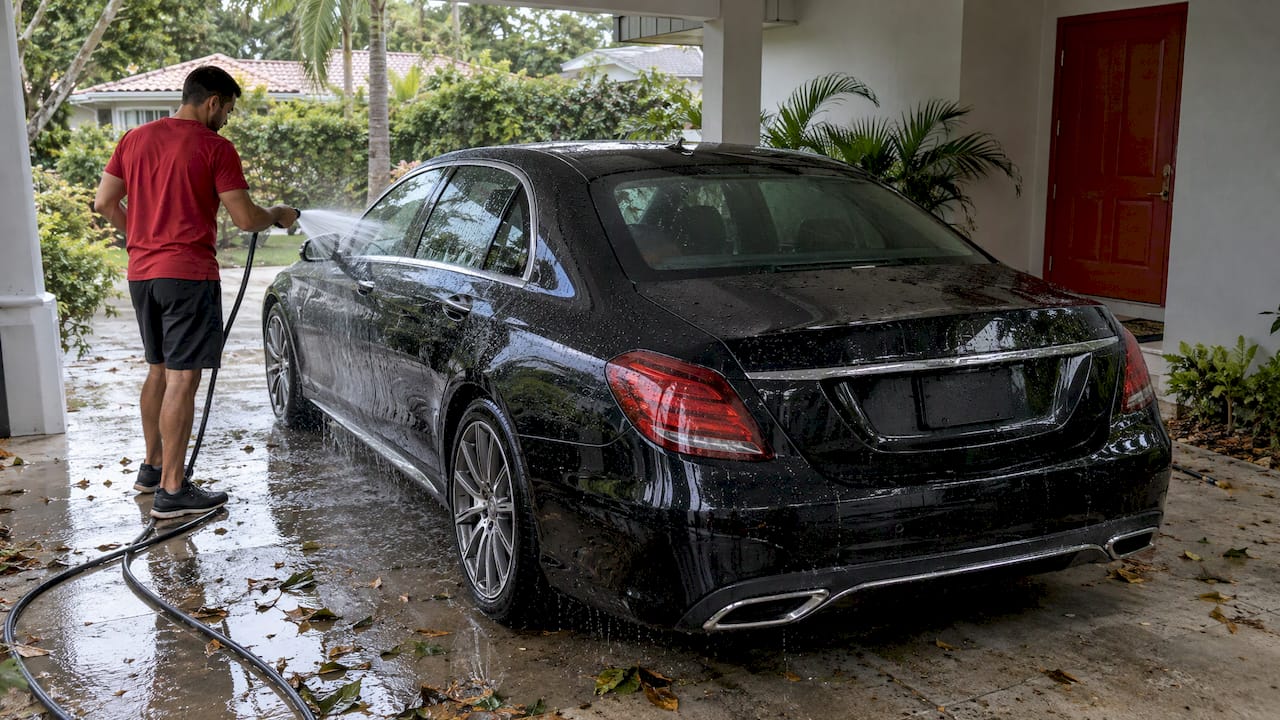
This is where we come in. Our Maintenance Detail starts at $199 and our Full Detail starts at $295. Every vehicle we service is personally inspected and approved by owner Steven Shames, and we offer mobile service, so a post-storm clean can happen at your home or office while you deal with the rest of the cleanup.
If you already have protection on the car, the same visit is a good time to have it checked. Our ceramic coating options start at $1,149 for Basic Ceramic, and our paint protection film starts at $1,000 for a Basic Front End. Film is designed to absorb rock chips and road damage, and a coating gives the paint a hydrophobic surface that makes salt and grime easier to wash away. Our guides to Florida sun and salty air and to ceramic coating versus wax explain how each option holds up in South Florida conditions, and our protection packages bundle coating and film.
If you manage several vehicles, our Fleet Maintenance Program and Executive Member Services are built for owners who need a recurring schedule instead of a one-time call. A booked clean after every named storm is a simple thing to put on that schedule.

If you want the paint assessed after a storm, start with our car detailing page and tell us what the car went through.
Our perspective
Every hurricane season, the owners who come out ahead did the boring things early. They moved the car before the roads filled, took the photos, checked the policy, and picked a spot with a real roof over it. Nothing we apply to paint changes what a flood does to a car, and we would never tell you otherwise.
What we do control is the finish. A car that goes into the season with a well-maintained surface comes out of it easier to restore, because salt, grit and residue wash off a clean, protected surface more readily than off bare, neglected paint. That is why we like to talk about protection as a year-round routine: ceramic coating for a slick, hydrophobic surface, and paint protection film for rock chips and road damage.
When the storm is over, every car we service gets a personal inspection and approval from me. I want you to see the paint look the way it did before the weather came through, and our mobile option means you do not have to bring the car to us to get there.
Martin
FAQ
Where is the safest place to park my car during a hurricane?
The safest place is an interior garage above flood level, or an upper floor of a sturdy parking structure, away from trees, power lines and signs. If neither is available, park on the highest ground you can find, beside a strong building that blocks the wind. Never leave it in a low-lying lot or on a street that floods.
Should I put a cover on my car for a hurricane?
A cover helps as an added layer inside a garage or beside a solid structure, and it should be heavy-duty, snug and larger than the car's body panels, as Kelley Blue Book describes. It does not replace a safe location. Put it on a clean car, close the windows and sunroof first, and remove it after the storm so moisture does not sit on the paint.
Does car insurance cover hurricane damage in Florida?
Only comprehensive coverage does. It generally covers wind, falling debris and flooding caused by the storm, subject to your deductible and policy terms. Liability-only coverage does not pay for flood damage to your car. Confirm what you carry with your insurance agent well before a storm approaches.
When should I move my car before a hurricane?
About 24 hours before expected landfall is the timeline Kelley Blue Book recommends for moving the car to high ground or a garage. Fill the tank and photograph the car at around 72 hours. If an evacuation order covers your area, leave earlier and follow local officials.
What should I do if my car is flooded?
Do not start it. Treat it as a collision for claims purposes, call your insurer, and have it inspected before it is driven. For an EV, Ford's guidance is to wait for a technician and tow it well away from structures. Once the car is cleared and repaired, we can handle the paint and interior detail.
Sources
- Hurricanes | Ready.gov
- STEP Supplemental Hazard Lesson: Floods | Ready.gov
- Preparing Your Car for a Hurricane: An Emergency Checklist | Kelley Blue Book
- How to Prepare Your Car for Hurricane Season | AAA
- How to protect your car during severe weather | Chubb
- Vehicle Safety During Severe Weather | GEICO
- How to Prepare Your Car for a Hurricane | Progressive
- Protecting your car during a hurricane | Dairyland
- Vehicle Safety Tips for Hurricane Season | First Florida
- Submerged Ford electric vehicle guidance | Ford
- Post-Disaster Guide | Louisiana Department of Insurance
- Natural Disasters Guide | Alabama Department of Insurance
- Does Car Insurance Cover Natural Disasters? | Lemonade
- Hurricane Season Timeline | Storm Smart
- Hurricane and Flood Damage to Your Car: What Florida Auto Insurance Covers
- Miami Parking Authority