
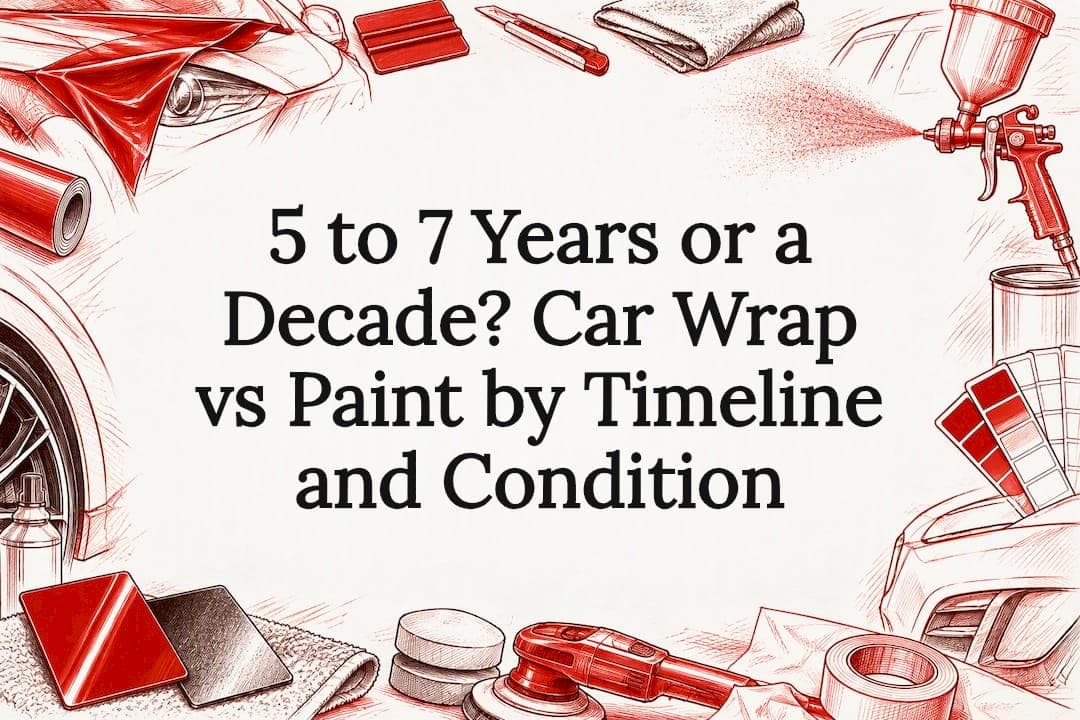
If you want a reversible, fast, custom finish, a vinyl wrap usually fits best; if you want permanence and the longest possible service life, quality paint wins. The right call depends on three things: your budget, how long you plan to keep the vehicle, and the finish type you actually want. Owners selling within a few years tend to lean toward wraps. Owners keeping a car a decade or more usually lean toward paint.
TL;DR:
- Quality wraps cost $2,000 to $6,000, while resprays with two coats cost $4,000 to $8,000; wraps require replacement every five to seven years.
- For 3M Series 2080, coverage reaches eight years on vertical panels but about three on horizontal panels, where sun and debris cause faster wear.
- Wrapping requires clean, sound paint; peeling, flaking, oxidation, rust, or prior bodywork may require correction first, adding costs before installation.
- Wrapped panels need hand or brushless washing because automated bristles can lift edges; remove bird droppings promptly and park in shade to limit damage.
- Before booking, confirm the installer is certified for the film brand and get panel specific warranty terms in writing before work begins.
Table of Contents
- Wrap vs Paint: Pros and Cons Side by Side
- Cost Comparison: Realistic Price Ranges and Cost Drivers
- Durability, Warranties, and Expected Lifespan
- Installation and Surface-Prep: Shop Checks and Red Flags
- Maintenance and Care: Carwash Rules and Daily Upkeep
- Decision Checklist: Which Option Matches Your Situation
- SSF Detail's Approach to Evaluating Wrap vs Paint
- A Pro's Quick Take on Wrap vs Paint
- Get a Professional Wrap or Paint Protection Quote
- FAQ
- Sources
Wrap vs Paint: Pros and Cons Side by Side
Vinyl wrap and paint solve overlapping problems in different ways, and the right pick usually comes down to what you value most: flexibility or permanence.
A wrap's biggest strengths are variety and speed. You can get matte, satin, chrome, or color-shift finishes that paint simply cannot reproduce, and a wrap can be installed in a fraction of the time a quality respray takes, often a day or two versus a week or more for paint. Because it sits on top of factory paint, a wrap also acts as a layer of protection, and removing it later can reveal the original finish if that paint was sound going in.
Paint's strengths run the other direction: depth, permanence, and a longer service life for owners who are not planning to change their look again. A well-applied, multi-stage paint job also holds up to more aggressive washing and daily wear without the edge-lift or fading risks that come with film.
Both finishes share one hard constraint: they need a clean, structurally sound panel underneath. Rust, dents, or old bodywork repairs can nullify a wrap's cost advantage fast, since you will pay for prep either way.
- Wrap wins for: custom colors, chrome, color-shift, graphics, and reversibility
- Paint wins for: long-term depth, resale consistency on classic or collector cars, and durability under heavy daily use
Cost Comparison: Realistic Price Ranges and Cost Drivers
Price is usually the first question, and the honest answer is "it depends on the vehicle and the finish," but the ranges are predictable.
A quality vinyl wrap typically runs roughly $2,000 to $6,000 for most passenger cars, with specialty finishes like chrome or color-shift, plus larger vehicles, pushing costs past $10,000. Curved panels, complex body lines, and premium films all add labor hours, which is where most of the extra cost comes from.

Paint price bands are wider. A basic single-stage respray can land around $1,500 to $3,500, a thorough two-stage job often runs $4,000 to $8,000, and show-quality or restoration-level paint work can cost significantly more.
A typical quality wrap costs less upfront than a quality two-stage respray, but wraps need removal and eventual replacement every five to seven years, while good paint can outlast two or three wrap cycles, according to Car and Driver's cost breakdown.
- Vehicle size and body complexity raise both wrap and paint costs
- Specialty films (chrome, color-shift, printed graphics) cost more than solid colors
- Factor in eventual wrap removal or future repaint when comparing lifetime cost
Durability, Warranties, and Expected Lifespan
Lifespan expectations differ sharply between the two finishes, and panel orientation matters more than most owners realize.

Quality wraps commonly last about five years under normal exposure, sometimes stretching to seven with careful care and garage storage. Paint, by contrast, can last 10 to 20 years or longer when properly maintained, since it is bonded directly to the body rather than layered on top.
Manufacturer warranties are shorter on horizontal panels than vertical ones, and the gap is significant: 3M's Series 2080 film carries up to eight years of warranty coverage on vertical surfaces but only about three years on horizontal surfaces like hoods and roofs, where UV exposure and standing debris do the most damage.
- Horizontal panels (hood, roof, trunk) age faster under sun exposure
- Vertical panels (doors, fenders) typically see the longer warranty terms
- Garage storage and shade meaningfully extend service life for both finishes
For owners who want the best of both, pairing paint with ceramic coating or layering paint protection film over factory finish adds UV resistance and rock-chip defense without sacrificing permanence.
Installation and Surface-Prep: Shop Checks and Red Flags
Prep work is where quality installs separate from problems down the road, and it looks different for each finish.
Paint prep usually means sanding, addressing any bodywork, and priming before a single coat goes on. Wrap prep is less invasive but not simple: the surface needs to be clean and structurally sound, and tight areas like mirrors or bumpers often require edge tucking or partial panel removal.
Peeling, flaking, or heavily oxidized paint can disqualify a panel for wrapping outright, or require paint correction first, since manufacturer guidance notes that film should only go over sound, well-cured paint. Proper installation also follows post-heating and curing steps specified by the film manufacturer to prevent stretch memory and edge lifting over time.
- Ask whether the shop is a certified installer for the film brand they use
- Ask what warranty terms apply to horizontal versus vertical panels
- Ask how they handle disassembly around mirrors, handles, and trim
Pro Tip: Always get warranty terms in writing before the install begins, not after.
Maintenance and Care: Carwash Rules and Daily Upkeep
Day-to-day care directly affects how long either finish holds up, and the rules differ enough to matter.
Wrapped vehicles should avoid automated brush washes, since the bristles can lift edges and scratch film; a brushless or hand wash is the safer call. Painted vehicles tolerate a wider range of washing methods, though handwashing with proper pH-balanced soap still preserves the finish best over time.
Harsh solvents, some wax formulas, and abrasive polishing compounds can damage specialty wrap films, which is why ceramic coatings or a layer of paint protection film often make more sense as the protective layer rather than aggressive chemical cleaners.
- Hand wash or brushless wash only for wrapped panels
- Treat edge lifts or stains promptly before they spread
- Park in shade or a garage to limit UV fading and bird-sap etching
- Avoid parking under trees that drop sap or debris on horizontal panels
Pro Tip: Wipe bird droppings off within a few hours, both finishes etch faster than most owners expect.
Decision Checklist: Which Option Matches Your Situation
A quick way to settle the question is to run through five factors before you call a shop.
- Ownership horizon: keeping the car under 5 years favors wrap; 10+ years favors paint
- Desired finish: chrome, matte, or color-shift only comes from a wrap
- Vehicle condition: sound, healthy paint supports either option; damaged panels push you toward paint correction first
- Climate exposure: heavy sun or coastal salt air shortens both finishes faster, so plan maintenance accordingly
- Budget: compare total lifetime cost, not just the upfront number
Leasing a vehicle: wrap is almost always the better fit. Selling within five years: wrap protects resale paint underneath. Keeping a car past a decade: paint, often paired with ceramic coating, wins long term.
Before booking either service, ask your installer for warranty terms in writing and confirm they are certified for the film or coating brand they plan to use.
SSF Detail's Approach to Evaluating Wrap vs Paint
We treat every wrap or protection decision as a panel-by-panel inspection, not a one-size answer. Our car wrapping service starts with a close look at existing paint condition, because any oxidation or prior bodywork changes the prep plan before a single sheet of film goes down.
We sequence work to follow manufacturer instructions on curing, post-heating, and edge treatment, which keeps warranty coverage intact rather than voided by a rushed install. For owners who want permanence instead, we offer paint protection film and ceramic coating as a combination that locks in depth and gloss while adding real resistance to rock chips and UV fading.
Every vehicle that comes through our shop is personally reviewed before it leaves, ensuring attention to detail for all cars serviced.
A Pro's Quick Take on Wrap vs Paint
My rule of thumb with clients is simple: if you are still deciding how you want the car to look long term, wrap it and keep your options open. If you already know this is the paint you want for the next decade, invest in the respray and protect it properly from day one.
Most of the leasing and resale-focused clients I talk to land on wrap without much debate. Most of the collector and long-term owners land on paint paired with ceramic coating.
— Martin
Get a Professional Wrap or Paint Protection Quote
Whatever direction fits your timeline, we offer the service to match it. Choosing a wrap, a respray refresh, or a protective layer over existing paint all come down to the same inspection-first process we use on every vehicle.
- Want a custom look with reversibility: our Full Exterior Wrap service
- Want added depth and UV resistance on existing paint: ceramic coating options like Basic Ceramic or Pro Borophene
Reach out through our car detailing page to book an inspection. We will walk your panels, check for prior repairs, and recommend the finish that actually fits your plans for the vehicle.
FAQ
What is the downside of wrapping a car?
A wrap has a shorter service life than quality paint, typically around five years before fading or edge lifting becomes noticeable. It also requires careful washing, since brush carwashes can lift edges and damage the film over time.
Is it cheaper to wrap a car instead of painting?
A quality wrap often costs less upfront than a comparable two-stage respray, with wraps typically running $2,000 to $6,000 versus $4,000 to $8,000 for a thorough paint job. Over time, though, a wrap needs replacement roughly every five to seven years, while good paint can last a decade or longer without that recurring cost.
Can a vinyl wrapped car go through a carwash?
Yes, but brushless or handwash methods are strongly preferred over automated brush washes. Bristles can lift film edges and introduce fine scratches that shorten the wrap's appearance and lifespan.
What's the average cost to wrap your vehicle?
Most passenger cars fall in the $2,000 to $6,000 range for a quality wrap, with chrome, color-shift, or printed graphics pushing costs higher. Larger vehicles and complex body lines also add labor time, which raises the final price.
Sources
- Car Wrap Cost – Car and Driver
- 3M™ Wrap Film Series 2080 product information
- 3M Series 2080 FAQ / Technical guidance