
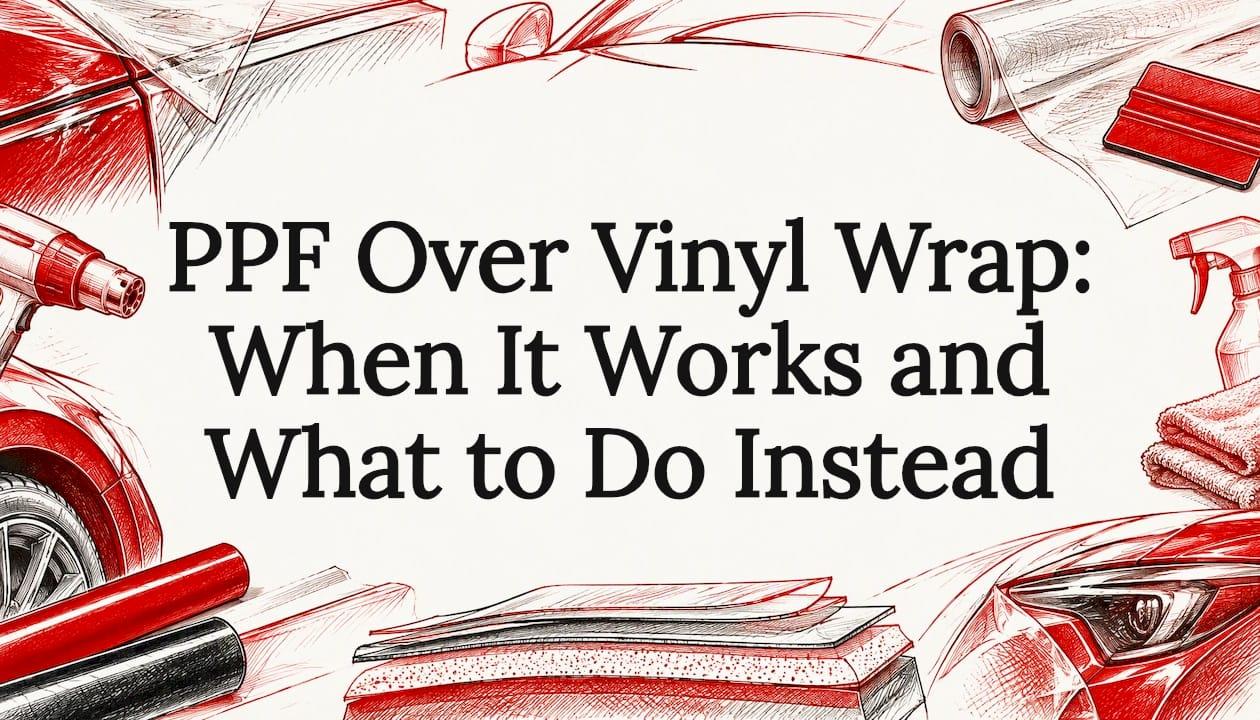
Yes, paint protection film (PPF) can physically be applied over a vinyl wrap, but it is the exception, not the standard method. Film makers write their installation instructions for paint, not for vinyl, and layering two films adds edge, adhesion and removal risks. For most luxury and exotic owners in Palm Beach County, the better order is PPF on the paint first, then color on top if you want it. If you are committed to a wrap for the long haul, a front-end PPF layer over it can be done, with conditions we cover below.
TL;DR
- PPF over vinyl is possible, but major film makers specify clean OEM paint as the surface, so a wrap sits outside their written instructions.
- The main risks are air trapped at wrap edges, bubbles over time, and damage to the wrap when the film is eventually removed.
- PPF on paint first, with the wrap over it, keeps the film where its instructions place it and lets you change color later.
- Layering over a wrap only makes sense if you will keep that wrap for years and want chip protection on the front end.
- Every vehicle at SSF Detail is personally inspected and approved by owner Steven Shames before it leaves.
Table of Contents
- What "PPF over vinyl" actually means
- Why the surface under the film matters
- Warranty: get it in writing first
- When layering over a wrap can make sense
- The order we recommend: PPF first, wrap second
- What it costs
- How a proper install is done
- Aftercare for PPF and wraps
- Our view on layering
- Plan your film and wrap with us
- Decision checklist before you book
- FAQ
- Sources
What "PPF over vinyl" actually means
Paint protection film is a clear urethane film, typically self-healing, that absorbs rock chips, road debris and light scratches. A vinyl wrap is a color or finish film that changes how the car looks. Layering them means installing the clear film on top of the colored film instead of directly on paint.
People ask about it for three reasons:
- They already have a wrap and want chip protection on the hood and bumper.
- They want a matte or satin color to stay protected without repainting.
- They are planning both and want to know which goes first.
The third question matters most, because the order decides how the whole project behaves for years.
Why the surface under the film matters
PPF adhesive is engineered to bond to automotive paint. Avery Dennison's instruction bulletin for dry-apply PPF states that the surface must be OEM paint in good condition, cleaned of dirt, grease, oil, wax and polish, and finished with an isopropyl alcohol wipe. A vinyl wrap is not that surface. It has its own adhesive layer, its own texture and, on a fresh install, its own curing period.
That does not mean the combination always fails. It means you are working outside the printed instructions, so the quality of the installer's judgment carries more weight than it normally would. Three things go wrong most often.
Trapped air at the edges
A wrap has edges: seams, cut lines, wrapped-around panel returns. Clear film that has to cross those edges can bridge them and leave tiny air pockets. Small pockets can grow over time with heat and sun, and in South Florida the heat is relentless. Once the two layers begin to separate, the only real fix is redoing the film.

Adhesion between two films
Wrap adhesive and PPF adhesive are made for different jobs. The PPF bonds to a vinyl surface rather than paint, and the vinyl itself is only as secure as its own bond to the paint underneath. If either layer lets go, both go. A wrap that is not fully cured, or an older wrap that has begun to age, is a poor base for anything.
Removal day
This is the risk owners forget. When the PPF eventually comes off, it can pull at the wrap beneath it. When the wrap comes off, it takes the film with it. You have effectively committed to two films that must age together. Our guide on PPF removal explains why older film is best handled by professionals using controlled heat rather than pulled by hand.
Warranty: get it in writing first
Film warranties generally cover defects in the film when it is installed the way the manufacturer recommends. An installation over vinyl may fall outside that, and some manufacturers say as much in their product materials. Before any film goes over a wrap, ask the installer to confirm in writing whether the film warranty applies and what the shop itself stands behind. If the answer is vague, change the plan, not the paperwork.
When layering over a wrap can make sense
We would consider PPF over vinyl in a narrow set of cases:
- The wrap is new and fully cured, and the film goes on within the window the wrap installer recommends.
- You plan to keep that wrap for many years. The film is a long-term product, so if the color might change in a year or two, the layering order is wrong.
- Coverage is limited to the front end, where stone strikes concentrate: the leading hood edge, bumper, fenders and mirrors.
- The wrap is a single layer in good condition, with no lifting, no old adhesive residue and no previous film beneath it.
- The design avoids hard, raised edges under the film, such as stripes or graphics the film must cross.
If any of those is not true, the answer changes to: put the PPF on paint.
The order we recommend: PPF first, wrap second
For most owners the cleanest sequence is:
- Correct any paint defects. Film locks in what is under it, so imperfections are sealed in rather than hidden. See paint correction before PPF for when this is worth doing.
- Install PPF directly on the paint, the surface it was designed for, on the panels that take the most abuse.
- Add the color wrap over the areas you want changed, if you want a color change at all.
This order does several things for you. The film bonds the way its maker intends. The paint stays protected whatever happens to the wrap. And when you tire of the color, the wrap can be replaced without the clear film having to come off with it. If you are weighing the long-term picture, our comparison of a car wrap versus paint by timeline and condition sets out how the timelines differ.
A related option is to ask about a color-change film installed directly on the paint, which keeps the product where its instructions place it. Our team can tell you which option suits your car at your consultation.
What it costs

Costs rise quickly with layering because you pay for two films and two installs. National reporting puts a full PPF installation at as much as $8,000, partly because installers may remove trim for clean edges, and notes that partial front, full front and full-body coverage are all common choices.
Our own published starting prices for PPF are:
| Coverage | Starting price |
|---|---|
| Basic Front End | from $1,000 |
| Full Front End | from $2,400 |
| Track Package | from $3,500 |
| Full Body PPF | from $5,999 |
The final price depends on the vehicle, the film and the panels covered. Wrap pricing is quoted per vehicle, so we do not list one here. Because the front end takes the impacts, most drivers get the greatest value from front-end coverage on paint, with the wrap added around it.
How a proper install is done
Whether the surface is paint or a cured wrap, the preparation is where the result is won or lost. 3M's installation guideline calls for removing any ceramic coating, cleaning with an adhesive cleaner, a non-ammonia glass cleaner and a clay bar pass, then waiting 15 minutes after installation before putting pressure on the film.
At each stage, here is what it takes and where it goes wrong:
- Decontamination. Wax, sealant, tar and oils stop adhesion. Residue left at the edges is the usual cause of lifting later. Every vehicle we take in is inspected, and the owner approves the result personally.
- Surface inspection. Film and wrap magnify flaws instead of hiding them. A single bright light shows swirls, chips and wrap imperfections before they are sealed in.
- Panel preparation. Clean edges matter more than anything else. Removing mirrors, handles or emblems where needed gives the film room to wrap an edge instead of stopping short.
- Application. Heat, stretch and positioning have to be controlled. Our guide on low-heat install rules for carbon fiber PPF shows how much heat discipline matters on sensitive surfaces, and the same care applies near wrap edges.
- Final check. A few small moisture pockets can settle as the film stabilizes, but contamination, creases and stressed edges need correction. A shop that checks the car again after the film settles catches these early.
Aftercare for PPF and wraps
How you treat the car in the first weeks matters as much as the install. Leave the car unwashed until the edges and adhesive have stabilized, and keep high-pressure water away from edges and seams, where it can force water under the film or lift it. After that:
- Hand wash with a pH-neutral soap and a clean microfiber mitt, using two buckets.
- Skip dish detergent, harsh glass cleaners and brush-style automatic washes.
- Do not aim a pressure washer at edges.
- Wash on a regular schedule rather than leaving contamination to bake on in the Florida sun.
Our PPF maintenance guide covers the routine in detail, and the guidance on polishing PPF shows what protects your film and what voids warranties. If you would rather not do it yourself, we offer a Monthly maintenance plan at $199 per month, and Maintenance Detail starts at $199.
Our view on layering
We get this question often from owners who already have a wrap and want to protect it, and from owners who are planning both at once.
Our answer comes from how we work. We treat every car as one project, not as separate jobs. That means deciding the order of films before anyone touches the paint, because the order decides how the car ages. When PPF goes on paint first, it sits on the surface it was made for, the paint underneath stays protected, and a future color change does not disturb it.
When an owner has a fresh, fully cured wrap and wants front-end protection, we look at the wrap's condition, the edges and the design, and we tell you plainly what we recommend. Every vehicle is personally inspected and approved by Steven Shames, so the decision gets an owner's eye before work begins and again before delivery.
For most cars that come through our Boca Raton shop, the recommendation is simple: protect the paint with film, then add the color you want.
Martin
Plan your film and wrap with us
If you have a wrap and want protection, or you are planning both, we can look at the car and recommend the order that suits how long you plan to keep it. We install paint protection film at three levels of coverage, from a front end package to full body, and we also offer full exterior wraps, ceramic coating and ongoing maintenance for cars in Palm Beach County, mobile or in our shop. You can see our PPF packages and request a quote or look at our wrap options.
If you want to understand the film options first, our complete PPF guide covers coverage, warranty and installation in Boca Raton.
Decision checklist before you book
Use these questions before any film goes over color:
- How long do I plan to keep this color? If the answer is under a few years, put PPF on paint.
- Is the wrap new, fully cured and in good condition, with no lifting?
- Which panels take the stone strikes? Cover those first.
- Will the installer confirm warranty terms in writing, for both the film and the work?
- What happens at removal? Ask how the layers will come off and what it costs.
- Does the car need paint correction before anything is sealed in?
The answers usually point to one order. For most owners it is paint, then film, then color.
FAQ
Can you wrap on top of PPF?
Yes, this is the common order. Wrap adhesive generally bonds well to a cured PPF topcoat, though the surface is slicker than paint, so a test piece and the wrap maker's guidance should come first. It keeps the PPF on the paint, where its instructions place it, and lets you change the wrap later.
Can you put PPF on a vinyl wrap?
It can be done, but it sits outside what film makers describe in their instructions, which specify OEM paint. It suits a new, fully cured, single-layer wrap that you plan to keep for years, usually on the front end only. Confirm warranty coverage in writing before the install.
Will PPF over vinyl damage the wrap?
The risk comes at removal and from trapped air at edges. If the bond between the two films is stronger than the bond between the wrap and the paint, taking off one layer can disturb the other. Putting the PPF on paint first avoids this.
How much does PPF cost?
Our published prices start at $1,000 for a Basic Front End, $2,400 for a Full Front End, $3,500 for the Track Package and $5,999 for Full Body PPF. Wrap pricing is quoted per vehicle. A layered project costs more because it needs two films and two installs.
How do I care for a wrapped or filmed car?
Hand wash with pH-neutral soap and two buckets, avoid pressure on edges and skip brush-style automatic washes. Wait until the film has stabilized before the first wash. Our PPF maintenance guide gives the full routine.
Sources
- Avery Dennison IB4.40 Dry Apply PPF Guidelines
- 3M Paint Protection Film Installation Guideline
- Motor1: Paint Protection Film (PPF) cost, benefits and value