
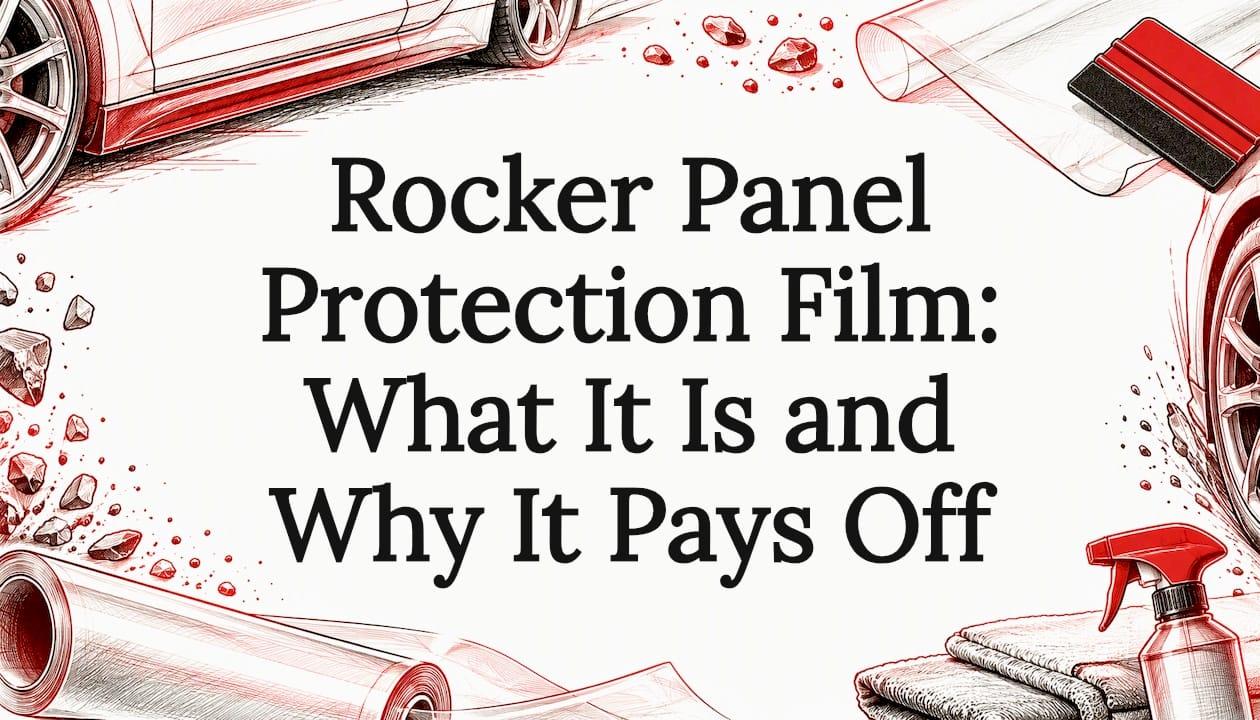
Rocker panel protection film is a clear, self-healing urethane layer applied to the strip of body below your doors, where tires throw gravel, sand and road grime at your paint all day. It is the cheapest way to stop the most common lower-body damage, and the result depends almost entirely on the film grade, the surface prep and the installer's trimming of edges. If you drive a luxury car, an SUV or a truck in Palm Beach County, this guide shows what the film covers, what to look for, how the install works and what to budget. When you are ready to price it, our paint protection film page lists our packages and gives you a free quote.
TL;DR
- Rocker panels sit low, right behind the front wheels, so they take the heaviest hits from gravel, sand, salt and tire spray. Clear film absorbs that damage instead of your paint.
- Look for a thermoplastic polyurethane (TPU) film with a self-healing top coat, a clear warranty and a precise fit around edges and trim.
- Professional installation matters most on rockers: the surface must be decontaminated, the film trimmed accurately and the edges sealed.
- Care is simple: wait before the first wash, keep pressure washers away from edges, and avoid abrasive or pigmented polishes.
- Our PPF packages start at $1,000 for a Basic Front End, and every vehicle we service is personally approved by owner Steven Shames.
Table of Contents
- What a rocker panel is and why it gets hit first
- What rocker panel PPF actually is
- What to look for in the film itself
- Rocker PPF versus generic guard tape or vinyl
- How rocker panel film is installed
- What it costs in Boca Raton and Palm Beach County
- Looking after filmed rockers
- Is the film legal and will it affect registration?
- Who benefits most
- Our point of view
- Ready to protect your rockers
- FAQ
- Sources
What a rocker panel is and why it gets hit first
The rocker panel is the lower body strip running between the front and rear wheel wells, directly under the doors. RealTruck's guide to rocker panels describes exactly that, and adds that how much of the panel you can see depends on the vehicle's design, trim, and whether it has running boards or side skirts. On a coupe or a sports sedan the rocker is a visible, painted sill. On a truck or SUV it may be partly hidden behind a step but still exposed to the spray.
The reason it gets damaged is its position. The same guide explains that its low, road-facing location exposes it to water, corrosive salt and gravel kicked up by the tires. That is the physical reality behind the chips you see along the bottom of a door: the front tire flings a particle, the particle travels a short distance at speed, and it lands on the first painted surface in its path.

That surface is often the rocker. Rockers also contribute to the rigidity of the body, so the metal underneath matters. Paint that chips down to bare metal on a low panel is a spot where moisture sits and corrosion can start, which is the reason the lower body deserves protection before the damage appears, not after.
For South Florida drivers, the threats look a little different from the Northeast: less road salt, but plenty of construction gravel, sand on shoulders, shell and limestone debris, and the constant sun. Rockers in a warm climate see abrasion first, and heat second.
What rocker panel PPF actually is
Paint protection film, or PPF, is a transparent urethane sheet that bonds to painted surfaces. Rocker panel PPF is the same film cut to the rocker's shape. It can be a vehicle-specific pre-cut kit or a pattern that your installer cuts to fit your exact car.
Avery Dennison's application bulletin for paint protection film names rocker panels among the body areas the film can be applied to, along with wheel arches, door edges and pillars. Because the film is colorless, the paint underneath shows through, so a rocker panel treated with PPF looks like an untouched rocker panel.
3M's Scotchgard user guide says its colorless urethane film helps protect high-impact areas from stone chips, scratches, bug damage, road tar stains and automotive-fluid stains. Those are precisely the things that collect along the sill of a daily-driven car.
What it protects against
- Stone chips and gravel: the main reason people film rockers.
- Scratches and scuffs: a shoe on the sill when someone climbs in or out, a garage wall, a stray shopping cart.
- Road tar and bugs: staining that etches into bare clear coat if left.
- Fluid stains: fuel, brake dust and similar residues that sit low on the body.
There is no film that makes a car invincible. A very large or sharp object at highway speed can still do damage, which is why the film is a layer of protection and not armor. What it does is take the repeated small impacts that otherwise accumulate into a dull, pitted sill.
What to look for in the film itself
Not all rocker film is the same. These are the qualities that matter, with figures from the manufacturers' own product pages.
Material and thickness
The better films use thermoplastic polyurethane (TPU). 3M's Scotchgard SGH12 is a virtually clear 12 mil (203 micron) TPU film with a UV-inhibitor clear coat. It is listed for rocker panels and carries a five-year warranty against yellowing, bubbling and cracking when installed by a 3M Certified Installer. A mil is a thousandth of an inch, so 12 mil is a substantial sheet, which is useful where impacts are most frequent.
Other manufacturers pitch their toughest grades at the same zone. STEK's DYNOmight is 10 mils thick with a 25% thicker TPU base layer, and it is designed for high-wear areas including wheel wells, side skirts and rocker panels. It has a 10-year warranty. SunTek's Ultra Defense is the brand's thickest film, intended for hoods, bumpers and rocker panels, with a 10-year limited manufacturer warranty.

The pattern is clear: thicker, high-grade film is the standard recommendation for the lowest, most impacted zones.
Self-healing top coat
A self-healing layer lets fine swirls and light scratches disappear with heat, from the sun or from warm water. SunTek says Ultra Defense self-heals using heat from the engine or sun, and adds hydrophobic stain resistance. Hydrophobic means the surface repels water, so dirt and road film rinse off more easily. In Florida, where the sun does much of the healing for free, this feature earns its keep.
Clarity and gloss
3M says its Scotchgard film offers excellent clarity and gloss retention, with a protective clear coat on top. On a rocker panel this matters because the sill sits at eye level when you are standing next to the car, and any haze, orange peel or yellowing shows. Clear, optically flat film disappears. Lower-grade film does not.
Warranty
A warranty tells you the film's expected life against yellowing, cracking and bubbling. Read what it covers and who must install it, since manufacturer warranties often depend on how the film is installed and cared for. Warranties on film do not cover impact damage from the road, so see them as a measure of film quality.
Rocker PPF versus generic guard tape or vinyl
Search results for this keyword include rugged black textured tape and rocker "guards" sold for DIY application, mostly aimed at trucks. These are a different product: a thick, pigmented, often textured PVC strip that sits on top of the paint and changes how the panel looks. Clear PPF does the opposite. It is meant to be invisible, it is made of urethane designed to flex over curves and heal minor marks, and it keeps the factory finish on display.
For a luxury vehicle, a sport coupe or any car where the paint color and finish are part of its value, a visible black strip defeats the purpose. Rocker PPF also follows body lines that a flat tape cannot, and it can be cut to the exact outline of the panel so the edge is nearly invisible.
That last point is where professional work shows. A film that is too small leaves a gap where gravel can still strike; a film that is too large rides up onto trim or into a seam and lifts. Pre-cut kits are drawn from the factory body data of a given model and year, and a good installer will still check the fit on your actual car before cutting or laying anything.
How rocker panel film is installed
The steps below follow Avery Dennison's published application procedure and the 3M guide. At each one we note where it goes wrong and what we do.
- Decide the coverage. The rocker can be filmed on its own, or as part of a front-end or full-body package. Decide early, because the film should wrap neatly at the door edges and wheel arches. We quote by coverage, and our PPF packages are built so that rockers can be part of the plan from the start.
- Inspect and correct the paint. The film locks in whatever is underneath. Swirls, etching and chips under the film stay visible. Avery recommends clean, fully cured OEM-painted surfaces, and both Avery and 3M say repainted areas must be fully cured before film goes on. If your paint needs it, see our guide on paint correction before PPF.
- Remove wax and polish, then decontaminate and clean. Avery's procedure calls for removing wax and polish, decontaminating the surface and wiping with isopropyl alcohol. Rockers collect tar and road film, so this step takes longer there than on a hood. Skipped prep is the most common reason for lifting edges.
- Apply slip solution and position the film. A slip solution is a wetting liquid that lets the installer slide the film into position before it grabs. Positioning is where an experienced hand shows, since the film has to sit true to the body line along the whole length of the sill.
- Squeegee out water and air. Water and air are pushed out from the center to the edges. Leave pockets and you get bubbles; push too hard near an edge and you can stretch or distort the film.
- Trim and secure the edges. Avery stresses special attention to edges, corners, seams, curves and deep recesses. This is the step where lifting, dirt lines and peeling begin if it is done poorly.
- Cure. Both manufacturers give a waiting period: Avery says to wait 48 hours before washing, and 3M's guide says 24 hours. Follow the installer's instruction for your film.
Temperature matters too. 3M recommends surface and ambient temperatures of 55°F to 90°F during application. In South Florida's summer, that is a reason to install in a controlled shop. Our shop-based and mobile options let us work to the conditions the film needs.
The point of this list is not that you could do it yourself. It is that each stage is a place where small errors become visible at the bottom of your door for years. We handle all seven, and the owner personally approves the finished vehicle before it leaves.
What it costs in Boca Raton and Palm Beach County
Rocker panels alone are a small area, but the labor to do them cleanly is not trivial, and most owners choose to combine them with other high-impact zones. Our published starting prices for PPF in South Florida, as listed on our site, are:
| Package | Starting price |
|---|---|
| Basic Front End | from $1,000 |
| Full Front End | from $2,400 |
| Track Package | from $3,500 |
| Full Body PPF | from $5,999 |
These are "from" prices that depend on the vehicle. Because every car is different in size, body style and trim, we give a quote for your car, including any rocker panel coverage you want. Request one on our paint protection film page.
If you want both the paint finish and the film surface to stay slick, it is also worth asking about protection packages that pair ceramic coating with PPF.
Looking after filmed rockers
PPF is low maintenance, but a few habits make it last.
- Wait before the first wash. Follow the 24 to 48 hours given by the manufacturers above.
- Keep pressure away from edges. 3M warns against aiming a pressure washer or hose directly at film edges, since it can lift them. Rockers have long edges along the door and the lower skirt, so keep the nozzle at an angle and at a distance.
- Avoid abrasive or pigmented waxes and polishes. 3M's guide warns against them. Our article on whether you can polish PPF explains what works and what can void warranties.
- Wash with a gentle method. Our PPF maintenance guide gives the wash routine step by step.
When the lowest part of a car gets wet and dirty daily, a regular maintenance wash is the easiest way to keep road film from bonding to the surface. Our maintenance plans include a monthly option at $199 per month.
Is the film legal and will it affect registration?
Yes, it is legal. A U.S. film manufacturer's page notes that PPF is legal to install throughout the United States and does not interfere with registration or inspection. The same page says headlights, taillights and license plates should remain unobstructed, which is not an issue on rocker panels, and that film should be professionally installed without bubbling or discoloration.
Who benefits most
Some vehicles and drivers get more from rocker film than others.
- Low sports and luxury cars. The sill sits close to the road and the paint is expensive to refinish.
- Trucks and SUVs on gravel, job sites or beach access. The tires throw material straight at the rocker.
- Dark or high-gloss paint. Chips and haze show more.
- Leased vehicles and cars you plan to sell. Clean lower panels support resale condition.
- Fleet vehicles. Executive cars and service vehicles collect lower-body damage fast. Our fleet maintenance program is priced by custom quote.
If your paint is matte or satin, PPF choices change, and we cover that in our guide on PPF for matte paint.
Our point of view
Rocker panels are the part of the car owners forget until the day they crouch down and see the chips. By then, the damage is done and the film would have been a fraction of the cost of repainting a sill.
Our view is simple. Choose a high-grade film, prepare the paint properly, and trim the edges so the work looks like it came from the factory. That is why every vehicle we service is personally inspected and approved by Steven Shames before it goes back to you. With over 1,350 cars serviced, we have built our process around that final check.
If you drive something exotic or high-end, plan your film coverage together with the rest of the car: front end, rockers, door edges and, where it fits, a ceramic coating over the paint that stays exposed. We tailor the plan to the car and to how you drive it.
Martin
Ready to protect your rockers
We install paint protection film in Boca Raton and serve Palm Beach County, with shop-based and mobile options. Tell us the vehicle and what you want covered, and we will build a quote that includes the rocker panels along with the rest of the plan. Packages and a free quote are on our paint protection film page.
For more questions on film, coatings and maintenance, our FAQ page has short answers.
FAQ
Where exactly does rocker panel PPF go?
It goes on the lower body strip beneath the doors, between the front and rear wheel wells. Depending on the vehicle, the film may wrap up onto the lower door edge or end at a trim line. A precise outline for your model and trim avoids gaps.
How long does rocker panel film last?
That depends on the film and its care. Manufacturer warranties on premium films run from five years for 3M's SGH12 to 10 years for STEK's DYNOmight and SunTek's Ultra Defense. Gentle washing, avoiding pressure at the edges and keeping off abrasive polishes help it reach that life.
Is rocker PPF worth it if I already have ceramic coating?
They do different jobs. Ceramic coating adds a slick, hydrophobic surface layer, while PPF is a physical layer that absorbs chips and scuffs. Many owners film the high-impact zones such as the front end and rockers and coat the rest. Our ceramic coating options start at $1,149 for Basic Ceramic.
Can I film just the rocker panels?
Yes. Rockers can be done on their own or as part of a larger package. Because the labor and prep are similar either way, many owners add them to a front-end package. We quote based on your vehicle and coverage.
Can the film be removed later?
Yes, quality film is designed to be taken off, which is useful at resale or lease return. Removal is best done by a professional, since pulling film from lower panels can stress edges and the paint beneath if it is not done carefully.
Sources
- RealTruck: The Definitive Guide to Truck and Car Rocker Panels
- Avery Dennison: IB4.30 Paint Protection Film Application
- 3M Scotchgard Paint Protection Film User Guide
- 3M Scotchgard Paint Protection Film SGH12
- STEK DYNOmight Paint Protection Film
- SunTek Paint Protection Film Ultra Defense
- Rock Chips vs PPF: How Much Protection Do You Really Get?