
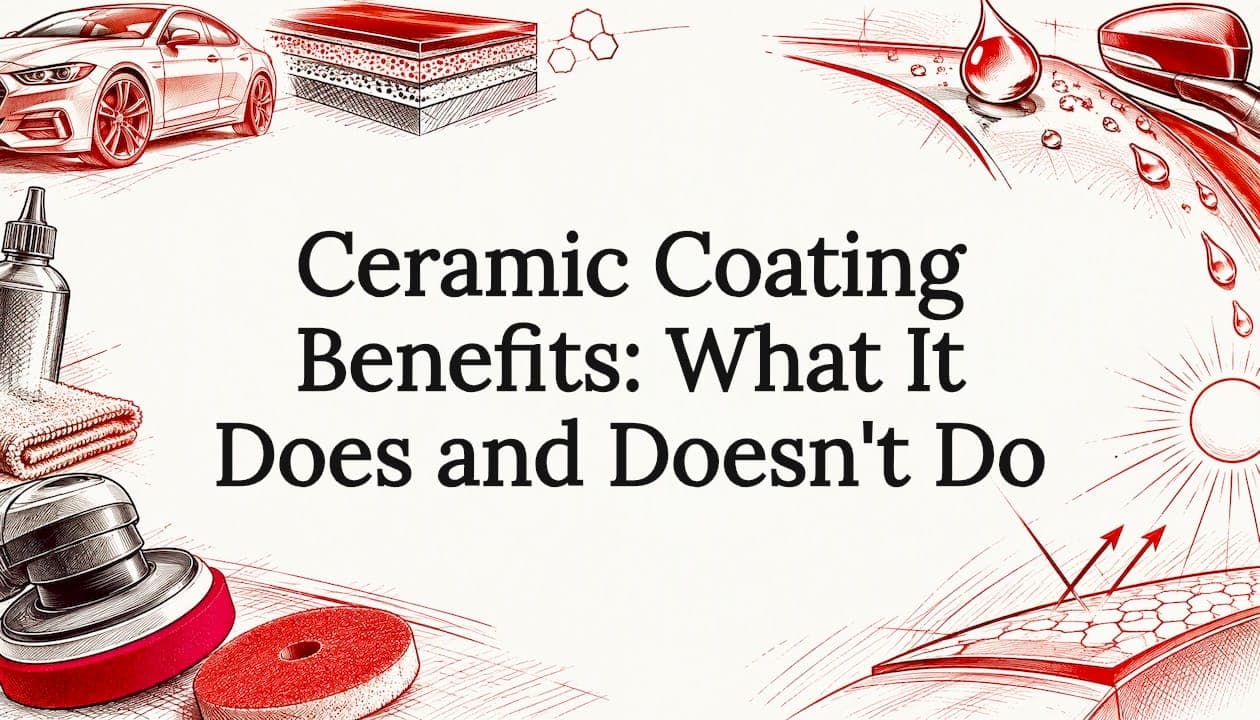
Ceramic coating gives your paint a hard, slick, hydrophobic layer. It resists UV, bird droppings, tree sap and road grime, makes washing faster, and deepens gloss. It isn't armor: rocks still chip paint, and it won't fix swirls already in the finish. For most owners who keep a car three or more years, it earns its cost. This guide explains each benefit, the limits, and how to decide.
TL;DR
- A ceramic coating bonds to your clear coat and adds resistance to UV, chemical stains, water spotting and everyday contamination.
- Its biggest day-to-day payoff is easier, faster washing and a deep, glossy finish.
- Most coatings last roughly two to five years with proper care, and wash habits matter more than the label on the bottle.
- It is not a substitute for paint protection film (PPF) when rock chips are your worry, and it won't remove existing scratches.
- It pays off most on a new or freshly corrected car you plan to keep, especially one parked outside in Florida sun.
Table of Contents
- What ceramic coating actually is
- The main benefits of ceramic coating
- What ceramic coating does not do
- How long ceramic coating lasts
- What ceramic coating costs, and whether it is worth it
- Why prep decides how good the benefits are
- Caring for a coated car
- Ceramic coating beyond paint
- Our perspective
- Choosing a coating with SSF Detail
- FAQ
- Sources
What ceramic coating actually is
Ceramic coating is a liquid polymer applied to a car's exterior. It forms a semi-permanent bond with the paint and adds protection against corrosion, environmental fallout, abrasion, oxidation and small scratches. Its main ingredient is silicon dioxide (SiO2), which makes up anywhere from 10 to 85 percent of a product, depending on the brand and formula. Titanium dioxide, polysiloxanes and solvents are other common components.

The key word is bond. Wax sits on top of paint and wears away in weeks. A coating cures into a thin, hard film, which is why it lasts years instead of months and why preparation before application matters so much.
The main benefits of ceramic coating
UV protection that slows fading and oxidation
Sunlight is what dulls and fades paint over time. One industry write-up reports that ceramic coatings can provide up to 95% UV protection, compared with about 70% for conventional coatings. That matters in South Florida, where cars sit in strong sun nearly all year. The coating takes the UV exposure instead of your clear coat.
Resistance to chemical stains and contamination
Bird droppings, tree sap, soot, bugs and road salts are acidic or sticky, and they etch unprotected paint when they sit. Motor1 notes that the biggest advantage of a coating is making paint more resistant to everyday contamination, including moisture, road grime, bugs, UV and chemicals. A coated surface gives you more time to remove a mess before it leaves a mark. It doesn't make the mess harmless, so rinse bird droppings promptly.
Hydrophobic behavior and easier washing
Water beads up and rolls off a coated panel, carrying dirt with it. That means fewer water spots and streaks and a faster wash. Dirt has a harder time gripping a slick surface, so a gentle hand wash removes it with less rubbing. Less rubbing means fewer wash-induced swirls over the life of the car.
Gloss, depth and a richer color
A coating adds depth and shine, much as a good wax does, only it lasts far longer. It won't change your car's color or hide defects, but on healthy paint it brings out clarity and a wet look. This is the benefit owners notice first, and the one they keep noticing every time they wash.

Some resistance to light scratches and heat
Ceramic coatings are rated between 7H and 9H on the pencil hardness scale, which makes them reasonably tough against minor marring. The same report notes that some can withstand temperatures beyond 1,000 degrees Fahrenheit. Treat this as extra resistance to light abrasion, not scratch-proofing. A key in the wrong hands or a shopping cart will still win.
Protection that helps resale appearance
Paint condition is one of the first things a buyer judges. USA Today observes that the upfront cost can be small next to the resale value lost to major scratches and swirls, since paint correction can run into the thousands. A coating that keeps paint glossy and clean supports that condition.
What ceramic coating does not do
Knowing the limits is how you get the full value out of a coating. It is a thin chemical layer, not a physical shield.
- It won't stop rock chips. Motor1 points out the coating is extremely thin compared with paint protection film and isn't designed to absorb the impact of rocks, gravel or shopping carts.
- It won't remove swirls or scratches. USA Today lists swirls, scratches and bodies needing paint correction among things a coating can't fix. Paint is corrected first, then sealed.
- It isn't maintenance-free. Easier to clean is not the same as never needing a wash. Mineral deposits, bird contamination and dirty wash media still need attention.
- Automatic brush washes shorten its life. The same USA Today piece says coatings can't endure automatic car wash brushes.
We say this plainly because it shapes the right choice. If your main concern is chips from highway debris, the answer is PPF on the impact areas, with ceramic coating over the top for slickness and easy cleaning if you want both. Our paint protection film options start with a Basic Front End package from $1,000.
How long ceramic coating lasts
Autotrader reports that most coatings last two to five years or 30,000 to 50,000 miles with proper maintenance. It puts consumer-grade bottled coatings at two to three years and professionally applied coatings at three to five. Mileage tends to matter more than the calendar, and a garaged car driven a few thousand miles a year may do better. Annual decontamination and a topper every few months help it hold up.
What shortens a coating's life:
- Automatic tunnel washes and harsh, high-pH soaps.
- Skipped or poorly done prep, because a coating can only bond to clean, corrected paint.
- Constant outdoor parking under strong sun, which is the norm for a lot of Palm Beach County drivers.
- Infrequent washing, which lets contaminants bake on.
We go deeper in our guide to field-tested ceramic coating lifespans and in our ceramic coating maintenance routine.
What ceramic coating costs, and whether it is worth it
Professional pricing varies with vehicle size, paint condition and coating tier. Car and Driver says shops charge more because of the prep work, and that an average pro-level job can cost as much as $2,000. Automoblog puts a professional detail with coating between $1,000 and $2,000, against $15 to $25 for high-quality DIY products.
Here is a simple way to think about value. A $1,500 coating that lasts three to four years works out to $375 to $500 a year. Set that against the hand wax, sealants and detail sprays you would otherwise buy, plus the time spent applying them.
Ceramic coating is usually worth it when:
- You bought a new or nearly new car and want to keep the paint in showroom condition.
- You plan to keep the vehicle three years or longer.
- It's parked outside or sees year-round sun, salt air and sudden rain.
- You value a faster, safer wash and a deep finish.
- Resale appearance matters to you.
It makes less sense when:
- You're returning a lease within a year.
- The paint is badly weathered and you don't want to pay for correction first.
- You rely on automatic tunnel washes and won't change that.
USA Today's own framing is similar: a heavily used, weathered car may not be a good candidate, while a brand-new vehicle is worth considering if you want to protect paint and resale value. For a Florida-specific breakdown, see our ceramic coating cost overview and our take on whether ceramic coating is worth it.
Why prep decides how good the benefits are
Every benefit above depends on what happens before the coating goes on. A coating locks in whatever is underneath, good or bad. That's why a quality job includes a full wash, chemical and clay decontamination, and paint correction where needed, before anything is applied. If you want to know what that step involves, read about whether you need a clay bar before ceramic coating.
After application, the coating needs time to cure. Car and Driver advises keeping the car dry and protected from dust, rain and contaminants for at least the first 24 hours while it bonds. A professional install in a controlled shop environment takes care of the application side. Your job afterward is gentle washing.
Caring for a coated car
A few habits protect the investment:
- Hand wash with a pH-neutral soap and clean microfiber, using the two-bucket method.
- Rinse off bird droppings, bugs and sap soon after you notice them.
- Avoid brush-style automatic washes.
- Dry the car rather than letting hard water air-dry in the sun, which leaves mineral spots.
- Schedule periodic maintenance details so the coating stays clean and slick.
If you'd rather not manage it yourself, our maintenance detail plans include a Maintenance Detail from $199 and a Monthly plan at $199 per month.
Ceramic coating beyond paint
The same logic applies to other surfaces. Wheels collect brake dust that bakes on, and a coating makes cleanup quicker; see our guide to wheel ceramic coating. Glass benefits from water repellency in heavy rain, covered in our piece on ceramic coating for glass. Owners of satin and matte finishes have their own needs, since those finishes can't be polished like gloss paint, and we cover them in ceramic coating for matte paint.
Our perspective
Most of the disappointment I see with ceramic coating comes from expecting the wrong thing. A coating won't stop a stone at 70 mph, and anyone who promises that is selling you something. What it does well is make paint resist the sun, salt air and everyday contamination, and keep a car easy to wash and glossy for years.
That's why every vehicle we service is personally inspected and approved by me before it goes back to its owner. The coating is only as good as the paint underneath it and the care taken in the prep, so we build each plan around the car in front of us: its age, its condition, where it's parked and how it's driven.
For high-end and exotic vehicles, we often recommend pairing the two protections: PPF on the high-impact areas, ceramic coating for slickness, UV resistance and easy maintenance. Over 1,350 cars serviced have taught us that the owners happiest with the result are the ones who understood what each layer does.
Martin
Choosing a coating with SSF Detail
We apply coatings at our Boca Raton shop and can also come to you with mobile service. Our three coating tiers are Basic Ceramic from $1,149, Advanced Graphene from $1,599 and Pro Borophene from $2,249. Which one fits depends on your vehicle, how you use it and how long you plan to keep it, and we'll walk you through that after inspecting the car.
See the full details on our ceramic coating page, or learn how sun and salt air affect paint in our guide to protecting your car from Florida's sunlight and salty air. Ready to book or ask a question? Start at ssfdetail.com.
FAQ
Is ceramic coating worth it?
For most owners who keep a car three years or more, yes. It makes paint easier to clean, adds gloss and resists UV and chemical contamination. It is less compelling on a short lease or on heavily weathered paint that hasn't been corrected.
What is the downside of ceramic coating?
It doesn't stop rock chips, remove existing scratches or survive brush-style automatic washes. Motor1 describes it as an added layer of protection rather than an invisible suit of armor. Used with that in mind, and paired with PPF where chips are a concern, it delivers what it promises.
How long does ceramic coating last?
Most coatings last two to five years with proper maintenance, and professionally applied coatings tend to be at the longer end. Wash technique, parking conditions and mileage all play a part.
Does ceramic coating replace paint protection film?
No, they do different jobs. PPF is a physical layer that absorbs chips and road debris, while ceramic coating handles chemical exposure, water behavior and easier cleaning. Many owners choose both.
Can ceramic coating hide scratches?
Not on its own. Existing swirls and scratches need paint correction before the coating is applied, because the coating seals in whatever is underneath it.
Sources
- Best Ceramic Coatings: Adding Protection to Your Car's Paint, MotorTrend
- What Is Ceramic Coating, And Is It Worth It?, Motor1
- What Are the Benefits of Ceramic Coatings on Cars?, AZoM
- Does ceramic coating your car really protect its paint?, USA Today
- How Long Does Ceramic Coating Last?, Autotrader
- Best Ceramic Coatings for 2026, Tested, Car and Driver
- Best Ceramic Coatings, Automoblog